
Unveiling the Pinnacle: A Deep Dive into the World’s Most Exceptional Hypercars in 2026
The automotive landscape of 2026 is nothing short of extraordinary, particularly within the rarefied air of hypercars. This elite segment, where engineering prowess meets artistic expression, has never been more vibrant or diverse. From the blistering speed of electric marvels to the visceral thrill of V12 titans, the modern hypercar represents the zenith of automotive achievement. This comprehensive exploration delves into the most significant machines defining this era, examining their groundbreaking technology, breathtaking performance, and the unique philosophies that set them apart. Whether you’re an aspiring collector, a technology enthusiast, or simply a lover of automotive excellence, the world of 2026 hypercars offers a spectacle unlike any other.
The Evolution of the Hypercar: A 2026 Perspective
The term “hypercar” once denoted a narrow category of extreme performance vehicles, typically defined by V12 engines and exclusivity. Today, the definition has broadened significantly, embracing the seismic shifts in automotive technology witnessed over the past decade. The rise of electric powertrains, in particular, has reshaped the very fabric of this segment.

In 2026, a hypercar is no longer solely defined by its internal combustion engine but by its ability to deliver a transcendent driving experience. This experience is now achieved through a dizzying array of configurations: pure-electric mega-watt machines, hybridized V12 track weapons, and even V8-powered analog rev-monsters. The benchmark for what constitutes a hypercar has been irrevocably elevated, with 1,000 horsepower now being the entry point rather than the ceiling.
Furthermore, the production numbers have shifted. While marques like Bugatti and Koenigsegg continue to build their machines in strictly limited numbers, a new breed of hypercar manufacturers is emerging, often utilizing advanced additive manufacturing and revolutionary construction techniques to deliver vehicles that challenge traditional notions of performance and accessibility.
The Unrivaled Icons: The Best Hypercars of 2026
In 2026, a select group of vehicles stands above the rest, representing the pinnacle of automotive engineering and design. These are the cars that grace bedroom walls, dominate auction headlines, and redefine what is possible on four wheels.
The Rimac Nevera R: The Electric Apex Predator
If any vehicle epitomizes the 2026 hypercar landscape, it is the Rimac Nevera R. This Croatian-built electric masterpiece has shattered the performance ceiling, proving that battery power can indeed eclipse the internal combustion engine in terms of raw speed and acceleration.
At the heart of the Nevera R lies a quad-motor electric architecture, each wheel independently driven by its own high-performance motor. This setup delivers a staggering 2,078 horsepower and over 1,740 lb-ft of torque. The result is a 0-60 mph time that borders on the surreal: an astonishing 1.7 seconds. This figure is not merely a headline statistic; it represents a fundamental shift in the physics of acceleration, leaving even the most potent gasoline hypercars trailing in its wake.
Beyond its headline numbers, the Nevera R is a testament to Rimac’s engineering genius. The company, now a critical technology partner to marques like Porsche and Hyundai, has leveraged its expertise in electric powertrains to create a chassis that is both dynamically brilliant and surprisingly exploitable. The torque vectoring capabilities of the quad-motor setup allow for unparalleled agility, transforming a vehicle weighing over 2,150 kg into a scalpel on the track. Senior staff writer Yousuf Ashraf’s experience at the Goodwood Festival of Speed, where he tamed the Nevera R on the famous hill climb, underscores its remarkable accessibility despite its colossal power output.
In 2026, the Nevera R is not just a car; it is a statement. It signifies the arrival of electric hypercars as the dominant force in the segment, setting a benchmark that all others must now aspire to meet.
The Bugatti Tourbillon: A Symphony of V16 Power and Electric Precision
The departure of Bugatti’s legendary quad-turbo W16 engine marked the end of an era. However, the Bugatti-Rimac partnership has ushered in a new dawn with the Tourbillon, a vehicle that honors Bugatti’s legacy while embracing the future of performance.
The Tourbillon replaces the W16 with a naturally aspirated 8.3-liter V16 engine, developed in collaboration with Cosworth. This magnificent powerplant, capable of revving to 9,000 rpm, produces a formidable 986 horsepower on its own. However, in true Bugatti fashion, the combustion engine is augmented by a sophisticated hybrid system. Three electric motors—two on the front axle and one at the rear—boost the total output to a mind-bending 1,775 horsepower.
What truly sets the Tourbillon apart is its spectacular engineering. The car features an 80-volt electrical system, one of the highest voltages ever implemented in a production road car, enabling ultra-fast charging and seamless power delivery. The chassis is a marvel of carbon fiber construction, providing the rigidity necessary to handle the immense power.

Visually, the Tourbillon is a masterpiece of automotive sculpture. It pays homage to the elegant lines of Bugatti’s classic Grand Prix racers while maintaining a distinctly modern aesthetic. The interior is equally breathtaking, featuring a stunning titanium steering column and a “dead-leaf” silver instrument cluster that serves as a functional work of art.
With a production run limited to just 250 examples and a price tag starting at €3.6 million, the Tourbillon is an extraordinarily exclusive machine. Yet, for those fortunate enough to experience it, the Tourbillon promises a driving experience that is nothing short of sublime—a perfect marriage of Bugatti’s traditional craftsmanship and Rimac’s cutting-edge technology.
The Pagani Utopia: The Art of Hypercar Engineering
Horacio Pagani has long been revered for his ability to fuse art with automotive engineering. His creations are not merely cars; they are rolling sculptures, meticulously crafted works of art that push the boundaries of what is possible in terms of design and materials science. The Pagani Utopia, the successor to the legendary Huayra, represents the zenith of this philosophy.
At the heart of the Utopia lies a bespoke twin-turbocharged V12 engine, developed in collaboration with Mercedes-AMG. This magnificent powerplant produces 852 horsepower and 811 lb-ft of torque, delivered through a delightful seven-speed manual transmission. In a segment increasingly dominated by dual-clutch automatics, Pagani’s commitment to the manual gearbox is a bold statement, offering a level of driver engagement that is increasingly rare.
The Utopia’s construction is a testament to Pagani’s obsession with detail. The chassis is a sophisticated monocoque of carbon-titanium composite, providing exceptional torsional rigidity while maintaining a featherlight curb weight of just 1,280 kg. Every surface, every component, has been meticulously sculpted and finished to the highest possible standard. The suspension is a work of art in itself, featuring forged aluminum wishbones and electronically controlled adaptive dampers that deliver a ride quality that is both supple and composed.
The interior of the Utopia is an immersive experience. The driver is cocooned in a cockpit of unparalleled luxury and craftsmanship, surrounded by hand-stitched leather, polished aluminum, and intricately finished carbon fiber. The digital displays are seamlessly integrated into the design, providing essential information without detracting from the analog feel of the driving experience.
The Pagani Utopia is more than just a fast car; it is an experience. It is a celebration of the art of automotive engineering, a testament to the power of human ingenuity, and a reminder that true luxury lies in the details.
The Aston Martin Valkyrie: A Formula 1 Car for the Road
When Aston Martin announced its intentions with the Valkyrie in 2016, the motoring world was left breathless. This was not merely a new hypercar; it was a radical rethinking of the concept, born from a collaboration between Aston Martin and Adrian Newey, the legendary Formula 1 aerodynamicist.
The Valkyrie is, in essence, a Le Mans prototype adapted for road use. Its Cosworth-derived 6.5-liter V12 engine screams to a stratospheric 11,000 rpm, producing 1,139 horsepower. This naturally aspirated masterpiece is augmented by a hybrid system, adding further power and torque to the equation.
What truly sets the Valkyrie apart is its aerodynamics. Newey’s design philosophy is evident in every curve and contour of the car. The bodywork is sculpted to generate an astonishing amount of downforce, effectively pressing the car to the track with forces that would overwhelm conventional vehicles. While the production version has had to scale back some of its more extreme aerodynamic ambitions due to road homologation requirements, the Valkyrie remains a formidable machine on the track, capable of generating hundreds of kilograms of downforce.
The driving experience in the Valkyrie is nothing short of visceral. The cockpit is a snug, fighter-jet-like environment, with the driver sitting inches from the screaming V12. The steering is direct and communicative, providing a level of feedback that is rarely experienced in road cars. Every sensation—the vibration of the engine, the pull of the downforce, the precision of the steering—combines to create an immersive and exhilarating experience.
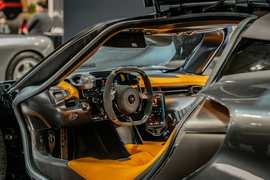
The Aston Martin Valkyrie is not a car for the faint of heart. It is a raw,