
The hypercar landscape of 2026 is nothing short of electrifying, both literally and figuratively. We’re witnessing an automotive epoch where the line between road-legal marvels and Le Mans prototypes blurs with unprecedented audacity. Forget the days when a ‘fast car’ meant simply a high top speed; today’s hypercars are symphonies of engineering, blending organic combustion artistry with the surgical precision of electric propulsion. The market is not just strong—it’s a supernova of demand, with exclusive creations fetching prices that would make a Formula 1 budget look quaint.
For the discerning enthusiast, the collector, or the dreamer whose bedroom walls are currently adorned with these four-wheeled titans, the choices have never been more exhilarating, nor more complex. Whether you’re seeking the visceral, analog scream of a naturally aspirated V12 or the gut-punching, instantaneous torque of a gigawatt-level electric drivetrain, the modern era delivers. This is not just about owning a fast car; it’s about curating a piece of history, a kinetic sculpture that challenges the very definition of what is possible on four wheels.
The titans of this industry—Bugatti, Ferrari, McLaren, Pagani—are no longer content with incremental improvements. They are engaged in a Darwinian race for supremacy, pushing materials science, aerodynamic efficiency, and energy density to their breaking points. Yet, amidst this technological arms race, a refreshing counter-narrative is emerging. The ghost of the purely analog machine, personified by visionaries like Gordon Murray and Horacio Pagani, is far from dead. They remind us that true automotive nirvana isn’t just about the numbers on a spec sheet; it’s about the tactile connection, the auditory theater, and the emotional resonance that only a masterfully crafted internal combustion engine can provide.
As we navigate this dazzling, multi-faceted market, one thing is clear: the hypercar of 2026 is a reflection of our times—a perfect storm of excess, innovation, and an unyielding passion for the automotive sublime. Join us as we explore the benchmark machines that define this golden era, the highly anticipated successors on the horizon, and the wildcards that are rewriting the rulebook entirely.
The Pantheon of Power: Defining the Best Hypercars of 2026
The term ‘hypercar’ itself is a fluid concept, constantly being redefined by the very machines it seeks to classify. In 2026, this definition encompasses a stunning spectrum of engineering philosophies. At one end, we have the established dynasties—legacy brands that have spent decades perfecting the art of the high-performance automobile. These marques bring an almost religious devotion to heritage, yet they are simultaneously embracing the future with a fervor that surprises even their most ardent critics.
At the other end of the spectrum, we witness the meteoric rise of new entrants, often leveraging revolutionary manufacturing techniques like 3D printing and computational fluid dynamics to create machines that look and perform like they were beamed from the 22nd century. These newcomers are not merely competing; they are disrupting, challenging the very notion of what a limited-production vehicle can be.
Let us delve into the current pantheon, the undisputed champions that are setting the benchmarks for performance, luxury, and desirability in the mid-2020s.
The Maranello Maestros: Ferrari’s Electric Evolution
Ferrari, a name synonymous with passion and racing pedigree, finds itself at a fascinating crossroads. While the iconic V12 engine remains the spiritual heart of the brand, Maranello has demonstrated that it can pivot with breathtaking agility when the circumstances demand it.
The Ferrari F80, the marque’s ultimate expression of hybrid hypercar technology, stands as a testament to this adaptability. Eschewing the traditional V12 for a compact yet ferocious 3.0-liter twin-turbocharged V6, Ferrari has achieved a staggering combined output of 1,187 horsepower. This mechanical sleight of hand, augmented by advanced MGU-K and MGU-H electric motors, allows the F80 to channel its power with surgical precision. Its aerodynamic philosophy is deeply rooted in Formula 1, featuring complex active aero elements that generate downforce levels previously reserved for prototype racers. The result is a machine that doesn’t just feel fast; it feels like an extension of the driver’s will, a seamless interface between human intent and mechanical execution.
Complementing this halo model is the Ferrari 849 Testarossa, a vehicle that effectively replaces the SF90 Stradale as the marque’s plug-in hybrid entry point, yet performs with the poise of a true supercar. It proves that Ferrari is not merely chasing lap times; it is obsessed with the purity of the driving experience. The integration of its electric and combustion systems is so seamless, so transparent, that the driver is free to focus on the ballet of the apex rather than the complexity of the technology.
The W16 Dynasty: Bugatti’s Grand Finale
For two decades, the automotive world has been captivated, and frankly, humbled, by Bugatti’s quad-turbocharged W16 engine. This engineering behemoth, a relic of a bygone era of excessive automotive ambition, has powered some of the most iconic and terrifyingly fast machines ever conceived. In 2026, we stand on the precipice of its swan song, a moment of bittersweet reverence for the engineers at Molsheim.
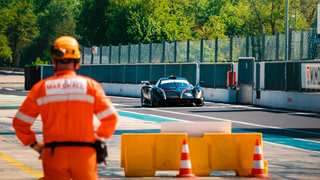
The Bugatti Mistral, the final roadster to bear the W16 heart, is a masterpiece of dramatic design and brute force. With a staggering 1,578 horsepower, it cemented its status as the fastest production roadster ever built, shattering the 280 mph barrier. Yet, the Mistral is more than just a collection of terrifying statistics. It represents the culmination of the Chiron’s technological prowess, refined into a more emotional, more tactile package. The removal of the roof allows the thunderous symphony of the W16 to resonate in its purest form, creating an auditory experience that is both exhilarating and slightly alarming.
The Bugatti Chiron Super Sport, the long-range speed king, continues to dominate the high-speed circuit. Its ability to effortlessly dispatch 0-60 mph in under 2.5 seconds and its mind-bending top speed capabilities make it the ultimate expression of straight-line performance. While its size and weight might preclude it from being the most agile track weapon, its stability and composure at speeds that defy belief are nothing short of miraculous.
The Koenigsegg Anomaly: Engineering Without Compromise
In the often-staid world of automotive luxury, Koenigsegg stands as a beacon of radical innovation and fearless engineering. The Swedish marque, helmed by the visionary Christian von Koenigsegg, operates with a philosophy that borders on the fanatical: build the fastest, lightest, and most technologically advanced car possible, regardless of cost or complexity.
The Koenigsegg Agera RS, though now superseded by newer models, remains an icon of this philosophy. It captured the coveted title of the world’s fastest production car, a feat achieved through a combination of raw power, aerodynamic genius, and relentless attention to detail. Its 5.0-liter twin-turbo V8 produces over 1,150 horsepower, delivered through a lightweight chassis that seems to defy the laws of physics.
Looking to the future, the Koenigsegg CC850 is a fascinating exercise in automotive nostalgia mixed with cutting-edge technology. Celebrating the 50th birthday of its founder, this stunning machine pays homage to the original CC8S with its breathtaking design. However, the real marvel lies beneath the surface. Koenigsegg has developed a revolutionary ‘Engage Shift System’—a complex electro-mechanical linkage that allows the driver to operate the car as a true manual transmission with a clutch pedal and gated shifter, or as a lightning-fast automatic. This dual personality, combined with the car’s blistering performance, makes it one of the most unique and engaging hypercars on the market.
Pagani’s Artistry: The Soul of the Machine
For Horacio Pagani, a car is not merely a mode of transport; it is a work of art, a kinetic sculpture that engages all the senses. His creations are defined by an obsessive attention to detail, exotic materials, and an aesthetic beauty that transcends mere automotive design.
The Pagani Utopia, the successor to the legendary Huayra, is the apotheosis of this philosophy. Weighing just 1,280 kg and powered by a bespoke AMG twin-turbo V12 producing 852 horsepower, the Utopia is a study in balance. Pagani’s insistence on a traditional gated manual transmission in an era of dual-clutch dominance is a bold statement, prioritizing driver engagement over outright lap times. The interior is a dizzying array of exposed carbon fiber, supple leather, and intricately crafted metal components, making every journey feel like a first-class flight into the stratosphere of automotive excellence.
The Electric Revolution: Rimac’s Dominance
While many legacy automakers are cautiously dipping their toes into the electric hypercar pool, Rimac has plunged headfirst, establishing itself as the undisputed leader in the high-performance EV segment. The Croatian firm’s machines are not just fast; they are paradigm-shifting, rewriting the very definition of automotive acceleration.

The Rimac Nevera R is, quite simply, the fastest accelerating production car on the planet. With four independent electric motors generating a combined output of 2,078 horsepower and over 1,740 lb-ft of torque, it rockets from 0 to 60 mph in a scarcely believable 1.7 seconds. This instantaneous thrust is delivered with a level of refinement