
The Apex Predator: Charting the World’s Most Coveted Hypercars
In the stratified hierarchy of automotive excellence, the hypercar reigns supreme. It is a realm where conventional metrics of performance are not merely stretched but utterly annihilated. For a select cadre of manufacturers, engineering is not a trade but an obsession, resulting in machines that blur the line between road-legal vehicle and intercontinental ballistic missile. Having spent the better part of a decade immersed in the upper echelons of the automotive industry—from the hallowed pits of Monaco during Grand Prix season to the sterile precision of the Nürburgring—I can attest that these are not just cars; they are four-wheeled declarations of intent.
The term itself, “hypercar,” implies a category beyond the already rarefied air of the supercar. While a supercar represents the pinnacle of accessible, albeit expensive, performance engineering—think your classic Ferrari or Lamborghini—the hypercar operates on a different philosophical plane. It is a showcase for bleeding-edge technology, often borrowed directly from the crucible of Formula 1, married to materials science that reads like a NASA project brief. These are limited-run artifacts, often hand-built or assembled with obsessive attention to detail, ensuring that the owner is acquiring not just transportation, but a piece of moving sculpture.

The allure of the hypercar lies in its audacity. In an era increasingly dominated by electrification and autonomous driving, these machines stand defiantly as monuments to the internal combustion engine and the raw thrill of human control. They represent the final frontier of petrol-powered velocity, pushing the boundaries of physics with aerodynamics that defy logic and power outputs that sound more like typographical errors than horsepower ratings.
For the enthusiast, or indeed the investor, understanding this niche is crucial. The market for hypercars is notoriously opaque, driven by exclusivity, provenance, and brand heritage as much as raw performance figures. A Bugatti commands its price not just for its quad-turbo W16 engine, but for the legacy of Ettore Bugatti himself. A Pagani is valued for the artistic soul of its creator, Horacio Pagani.
This deep dive will dissect the ten most significant hypercars that currently dominate the landscape, analyzing the engineering prowess, market positioning, and sheer aesthetic impact that elevates them above all others. Prepare to enter a world where the impossible is merely a design challenge.
The Valkyrie Enigma: Aston Martin’s Formula 1 Odyssey
When Aston Martin, a marque synonymous with British elegance and the suave sophistication of James Bond, decided to enter the hypercar arena, they did not opt for a conventional sports car. Instead, they partnered with Red Bull Racing’s Adrian Newey, the undisputed tactical genius behind some of the most dominant Formula 1 cars in history. The result is the Aston Martin Valkyrie, a machine that looks less like it drove off a production line and more like it was surgically removed from a Grand Prix circuit.
The name itself, derived from Norse mythology, evokes the powerful female figures who choose who lives and dies on the battlefield—a fitting metaphor for a car that subjects its driver to extreme G-forces. The design philosophy here is purely functional: aerodynamic efficiency above all else. The bodywork is a masterclass in “downforce sculpting,” featuring a massive central tunnel that channels air from the front splitter, through the underbody, and out the rear diffuser. This creates a vacuum effect, essentially sucking the car to the tarmac at high speeds.
Powering this technological marvel is a bespoke 6.5-liter Cosworth V12 engine. This naturally aspirated behemoth screams to a stratospheric 11,100 rpm redline, producing a staggering 1,000 horsepower. It is augmented by a Rimac-sourced Kinetic Energy Recovery System (KERS), bringing the total output to an eye-watering 1,160 hp. The power-to-weight ratio is theoretically 1:1, meaning the car weighs roughly as much as a small sedan but generates the horsepower of a small army.
Owning a Valkyrie is an exercise in commitment. Production is limited to just 150 road-legal coupes, with prices hovering around the $3 million mark. The driving experience is not for the faint of heart; it demands respect, precision, and a healthy disregard for conventional speed limits. It represents the ultimate fusion of Formula 1 engineering and luxury automotive craftsmanship, setting a benchmark for what a road-legal track weapon can achieve.
Bugatti Chiron: The Apex of W16 Grandeur
Following the revolutionary Bugatti Veyron, a car widely credited with birthing the modern hypercar category, the Bugatti Chiron faced an unenviable task: to improve upon perfection. Under the direction of Achim Anscheidt, Bugatti’s design chief, the Chiron retained the iconic silhouette but amplified every aspect of its predecessor. It is a testament to the W16 engine, an engineering marvel that few believed could be scaled and refined for production.
The heart of the Chiron is an 8.0-liter, quad-turbocharged W16 engine. In its most common iteration, it churns out 1,500 horsepower and 1,180 lb-ft of torque. This colossal power is delivered through a seven-speed dual-clutch transmission that can shift gears in a scarcely believable 150 milliseconds. The result is a 0-60 mph time of 2.4 seconds and a top speed electronically limited to 261 mph, though prototypes have unofficially touched 300 mph.
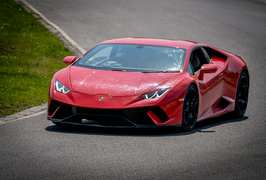
Beyond the staggering performance figures, the Chiron is a statement of opulent brutality. The interior is a cockpit of quilted leather, carbon fiber, and polished aluminum. Unlike the stripped-out racer aesthetic of some competitors, the Chiron prioritizes comfort for high-speed touring. It is a grand tourer built for the Autobahn, capable of crossing continents at breathtaking speeds with an air of effortless luxury.
The price tag reflects this dichotomy of purpose. Starting at around $3 million, the Chiron is one of the most expensive production cars ever made. Its limited production run, combined with Bugatti’s unwavering standards of exclusivity, ensures its status as a rolling artifact of automotive engineering history. It represents the zenith of the internal combustion engine, a majestic beast that may soon be extinct in its purest form.
Lamborghini Aventador: The Epitome of Italian Drama
No discussion of top-tier automotive performance is complete without the ferocious roar of a Lamborghini. While the company has flirted with hypercar territory with models like the Sesto Elemento, the Lamborghini Aventador remains the quintessential expression of the brand’s audacious spirit. It is a car that commands attention through sheer visual theater and an unwavering commitment to the V12 engine.
The original Aventador, launched in 2011, was a radical departure in design, characterized by its sharp, aggressive angles and scissor doors that became an instant icon. While later iterations like the SVJ (Super Veloce Jota) pushed the performance envelope further, the core recipe remained: a naturally aspirated V12 engine mounted transversely behind the driver.
In the most potent variants, such as the Aventador SVJ, this engine produces over 770 horsepower, rocketing the car from 0-60 mph in under 2.8 seconds. What sets the Aventador apart is its unadulterated, visceral character. It lacks the complex hybrid systems or turbocharging sophistication of its European rivals. Instead, it offers a raw, unfiltered connection between driver and machine. The sound alone is worth the price of admission—a high-pitched, operatic wail that echoes the golden age of Italian sports cars.
Priced around $420,000 for the base model, the Aventador offers a relative bargain in the hypercar space, though customization packages can push the price far higher. It represents a more accessible entry point into the world of extreme performance, proving that even without hybrid assistance, the V12 engine remains a force of nature.
The F1-Inspired Vision: Mercedes-AMG Project ONE
Mercedes-Benz, the dominant force in Formula 1 for much of the last decade, took the bold step of bringing its racing technology directly to the road with the Mercedes-AMG Project ONE. This audacious project represents a literal translation of Formula 1 hardware into a road-legal vehicle, a feat previously thought impossible due to packaging constraints and emissions regulations.
The heart of the Project ONE is a 1.6-liter V6 hybrid powertrain, derived directly from Lewis Hamilton’s championship-winning F1 car. This engine is augmented by four electric motors—one for each wheel—creating an all-wheel-drive system capable of vectoring torque with pinpoint accuracy. The combined output exceeds 1,000 horsepower, with an electric top speed of around 186 mph before the gasoline engine engages.
What makes the Project ONE truly unique is its engineering audacity. The V6 engine operates at up to 11,000 rpm, a screaming redline usually reserved for the racetrack. The electric motors are integrated into the turbocharger assembly, eliminating turbo lag entirely—a holy grail of performance engineering. The car features active aerodynamics, including a deployable DRS (Drag Reduction System) that allows the driver to manually reduce drag for straight-line speed.
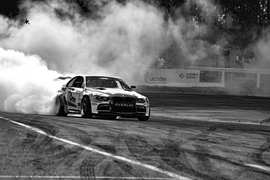
Limited to just 275 units worldwide, the Project ONE commands a price of approximately $2.7 million. It is a rolling testament to Mercedes-AMG’s engineering prowess, offering a driving experience that is as close as one can get to piloting a Grand Prix car on public roads. It blurs the line between racing prototype and production vehicle