
Title: The Apex Predators: A Deep Dive into the World’s Most Exquisite Hypercars
In the rarefied air of automotive excellence, where the pursuit of speed borders on the spiritual, exists a class of machine that renders traditional supercars mere children’s toys. These are the hypercars—the distilled essence of automotive engineering, where cutting-edge technology meets bespoke craftsmanship to create rolling works of art that challenge the very definition of what a car can be. For the discerning enthusiast, the collector with an insatiable appetite for the extraordinary, or the dreamer who gazes skyward at the sleek lines of a fighter jet, the world of hypercars offers a glimpse into a future where the boundaries between road and track dissolve into a blur of carbon fiber and pure, unadTHINKABLE power.
My decade-long immersion in the automotive industry, from the factory floors of performance manufacturers to the auction houses where legends are forged, has granted me a unique perspective on these mechanical marvels. I’ve witnessed firsthand the obsessive attention to detail that transforms a collection of high-end components into a cohesive, soul-stirring experience. This is not simply about horsepower figures or 0-to-60 times; it is about the symphony of a naturally aspirated V12 at 9,000 RPM, the subtle caress of a paddle shift that feels telepathic, and the G-forces that press you into a seat sculpted from a single block of carbon. It is a world where exclusivity is currency, and where the sticker price is merely the entry fee to an elite club.

Join me as we embark on a comprehensive exploration of the titans that dominate this exclusive realm. We will dissect the engineering marvels, the design philosophies, and the cultural impact of the vehicles that have redefined automotive performance. From the spiritual successors to road-legal Formula 1 cars to the reawakening of legendary marques, this is your definitive guide to the best hypercars currently available or soon to grace our planet.
The Blueprint of Brilliance: What Defines a Hypercar?
Before we delve into the specific machines that have captured the imagination of the world, it is crucial to understand what elevates a vehicle from the merely ‘super’ to the truly ‘hyper’. While the line can sometimes blur, several defining characteristics separate these apex predators from their high-performance brethren.
Firstly, power output is the most obvious differentiator. While a standard supercar might boast 600-700 horsepower, a hypercar typically shatters the 1,000-horsepower barrier, often achieved through the synergistic marriage of internal combustion and electric propulsion. This is not merely about straight-line speed; it is about the ability to overcome inertia with a violence that feels almost supernatural.
Secondly, exclusivity and price are intrinsic to the hypercar mystique. These are not mass-produced vehicles. Production runs are often limited to fewer than 500 units globally, and in many cases, significantly less. This scarcity drives prices into the millions, sometimes tens of millions, of dollars, creating an almost mythological status around each example that rolls off the assembly line. The waiting list alone can span years, with deposits often forfeited if a buyer fails to secure the allocation.
Thirdly, technological integration sets hypercars apart. Manufacturers often borrow heavily from motorsport, implanting race-derived chassis, suspension systems, and aerodynamic packages into road-legal frames. The materials science alone is staggering, with extensive use of carbon fiber, titanium, and advanced alloys to achieve a strength-to-weight ratio that was once the sole domain of aerospace engineering.
Finally, design language transcends mere aesthetics. Every curve, vent, and wing on a hypercar serves a dual purpose: to sculpt a form that is breathtaking to behold and to manipulate airflow with surgical precision. These are vehicles that utilize active aerodynamics—spoilers that deploy at speed, diffusers that adjust to optimize downforce, and bodywork that channels air to cool critical components—creating a visual ballet of performance in motion.
The Titans of Today: A Definitive Lineup
The landscape of hypercars is constantly evolving, with new contenders emerging to challenge the established order. However, certain names have cemented their legacy, while others are rapidly ascending to join their ranks. Here is our curated list of the most significant hypercars in the world today.
The Electrified Valkyrie: Aston Martin’s F1-Powered Marvel
When the venerable British marque Aston Martin decided to venture into the realm of hypercars, they did not simply want to build a fast car; they wanted to create a road-legal Formula 1 car. The result of this audacious ambition is the Aston Martin Valkyrie. Partnering with Adrian Newey, the legendary aerodynamicist behind Red Bull Racing’s championship-winning F1 cars, Aston Martin has forged a machine that blurs the lines between race track and public road in a way that is simply breathtaking.

At the heart of the Valkyrie lies a naturally aspirated V12 engine, a glorious, high-revving symphony of internal combustion that screams towards its 11,000 RPM redline. But this is not a brute-force V12 of yesteryear. It is augmented by a sophisticated hybrid system developed by Rimac, the Croatian electric hypercar pioneer. This combination yields a staggering 1,160 horsepower, all while maintaining a power-to-weight ratio that rivals the best F1 cars of its era.
The design of the Valkyrie is nothing short of radical. The bodywork is a masterclass in aerodynamic efficiency, with a dramatic underbody tunnel that channels air to generate immense downforce without the need for a massive rear wing. The cockpit is a snug, two-seat affair, reminiscent of a fighter jet, where the driver and passenger are cocooned in carbon fiber and Alcantara. Every surface serves a purpose, every curve is sculpted by the wind, and every detail speaks to a dedication to performance that borders on the obsessive.
The driving experience, as described by those fortunate enough to have sampled it, is visceral and immediate. The throttle response is instantaneous, the steering feedback is telepathic, and the way the car hunkers down and devours corners is unlike anything else on the road. The Aston Martin Valkyrie is not just a hypercar; it is a statement of intent, a testament to what happens when automotive passion collides with Formula 1 engineering.
The Reigning Monarch: Bugatti’s Chiron Successor
To follow in the tire tracks of the Bugatti Veyron, the car that single-handedly redefined the hypercar segment, was a task of Herculean proportions. Yet, Bugatti, under the stewardship of the Volkswagen Group, achieved the seemingly impossible with the Bugatti Chiron. This is not merely an evolution of the Veyron; it is a complete reimagining of what a grand touring hypercar can be.
The Chiron retains the iconic quad-turbocharged W16 engine, a 16-cylinder behemoth that displaces a full 8 liters. However, Bugatti’s engineers have coaxed an astonishing 1,500 horsepower from this already potent powerplant, thanks to a new two-stage turbocharging system and advanced cooling technologies. This immense power is sent to all four wheels through a sophisticated all-wheel-drive system, ensuring that the Chiron can deploy its might with surgical precision.
Visually, the Chiron is a masterpiece of automotive sculpture. It retains the signature Bugatti horseshoe grille and C-shaped side profile, but these classic elements are rendered in a more aggressive, modern interpretation. The bodywork is a complex interplay of carbon fiber panels and aerodynamic surfaces, with active elements that deploy at high speeds to enhance stability and braking. The interior is a study in luxurious excess, with hand-stitched leather, polished aluminum accents, and a center console that houses a rotating digital display that shifts between a classic analog tachometer and a modern digital interface.
The performance of the Chiron is simply staggering. It can accelerate from 0 to 62 mph in under 2.5 seconds, a feat that few cars can match. But where the Chiron truly shines is in its ability to maintain this velocity for extended periods. Its top speed is electronically limited to 261 mph, though the car is theoretically capable of speeds far exceeding that. This is a car designed not just for the drag strip, but for the autobahn, a machine that can cross continents in a single, breathtaking sweep.
The Hybrid Icon: Ferrari’s LaFerrari Successor
The legacy of Ferrari is inextricably linked to its V12 engines, the lifeblood of its most iconic models. With the Ferrari LaFerrari, the Prancing Horse embarked on a new chapter, one that embraced hybridization to unlock performance levels previously thought unattainable. This philosophy continues with its spiritual successor, a testament to Ferrari’s ability to blend tradition with innovation.
At the heart of this latest hypercar lies a naturally aspirated V12 engine, a screaming masterpiece of Italian engineering that revs to a dizzying 9,000 RPM. This auditory and visceral experience is complemented by a state-of-the-art hybrid system that provides instant torque to fill the gaps in the V12’s powerband. The combined output pushes well beyond 1,000 horsepower, creating a power delivery that is both ferocious and fluid.
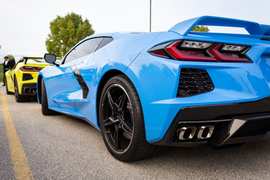
The design of the latest Ferrari hypercar is a bold departure from its predecessor, yet it retains the unmistakable DNA of the marque. The bodywork is a complex tapestry of aerodynamic surfaces, with active spoilers and diffusers that adjust in real-time to optimize downforce and minimize drag. The cabin is a driver-focused sanctuary, crafted from lightweight materials and wrapped in luxurious leather, offering a perfect