
The 10 Most Breathtaking Hypercars of the Modern Era: A Deep Dive into Automotive Perfection
In the rarefied atmosphere of automotive engineering, where the boundaries of possibility are constantly being redrawn, hypercars stand apart. They are not merely fast cars; they are rolling sculptures, engineering marvels, and testaments to human ingenuity. For the discerning enthusiast or the armchair aficionado, the world of hypercars offers a glimpse into a realm where performance, luxury, and design converge in spectacular fashion. This article delves into the crème de la crème of this exclusive category, exploring the vehicles that have come to define the modern hypercar era.
The Evolution of the Hypercar
Before exploring the titans of today, it is essential to understand what defines a hypercar. While the term is often used interchangeably with ‘supercar’, a hypercar represents the apex of automotive performance, typically exceeding the capabilities of even the most exotic supercars. Historically, the term gained prominence in the late 1990s, but its modern iteration has been shaped by a confluence of technological advancements, including hybrid powertrains, advanced materials, and computational design.
The modern hypercar is characterized by several key attributes:
Extreme Power Output: Typically exceeding 1,000 horsepower, often achieved through hybrid systems that combine internal combustion engines with electric motors.
Advanced Aerodynamics: Sophisticated active aero systems that adjust in real-time to optimize downforce and minimize drag.
Exotic Materials: Extensive use of carbon fiber, titanium, and other lightweight composites to achieve unprecedented power-to-weight ratios.
Limited Production: Scarcity is a defining feature, with most models produced in limited runs of fewer than 500 units, often much less.
Exorbitant Pricing: Prices typically start at $1 million and can soar into the tens of millions, reflecting the bespoke nature of their construction.
The modern hypercar landscape is a dynamic ecosystem where legacy automakers and boutique manufacturers vie for supremacy, each pushing the envelope of what is technically feasible.
The Aston Martin Valkyrie: A Formula 1 Car for the Road
When Aston Martin, a marque synonymous with James Bond-esque elegance, partnered with Adrian Newey, the legendary Formula 1 aerodynamicist behind Red Bull Racing’s championship-winning cars, the result was destined to be extraordinary. The Aston Martin Valkyrie is precisely that—an unapologetic fusion of road-legal civility and track-honed ferocity.
Design and Aerodynamics
The Valkyrie’s exterior is a masterclass in form following function. Its bodywork appears almost liquid, sculpted by the invisible forces of airflow. The car’s most striking feature is its underbody, a complex Venturi tunnel system that generates a significant portion of its downforce, allowing the car to generate more downforce than its own weight at speed. This design philosophy eschews traditional spoilers and wings in favor of subtle, integrated aerodynamic elements that maintain the car’s fluid silhouette.
Powertrain and Performance
At the heart of the Valkyrie lies a naturally aspirated 6.5-liter V12 engine developed by Cosworth. This high-revving masterpiece produces 1,000 horsepower on its own. However, the true genius of the Valkyrie lies in its hybrid system, developed in collaboration with Rimac. This KERS (Kinetic Energy Recovery System), similar to those used in Formula 1, adds an additional 160 horsepower, bringing the total output to a staggering 1,160 horsepower.
The power-to-weight ratio is the stuff of legend: approximately 1:1, meaning the car produces one horsepower for every kilogram of its weight. This results in a 0-60 mph time of around 2.5 seconds and a top speed in excess of 220 mph. The driving experience is said to be visceral, with the V12 engine singing a symphony of mechanical fury that few road cars can match.
Interior and Exclusivity
The interior of the Valkyrie is a minimalist, driver-focused cockpit that reflects its racing pedigree. The seating position is reclined, similar to a racing prototype, with the driver and passenger seated low within the carbon fiber tub. Every element is designed to reduce weight and enhance the connection between driver and machine. Production is strictly limited to 150 road-legal examples and 25 track-only variants, ensuring its exclusivity for the fortunate few who can afford its multi-million dollar price tag.
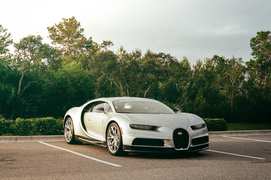
The Bugatti Chiron Super Sport 300+: Breaking the 300 MPH Barrier
For years, the quest for the 300 mph barrier was the holy grail of the automotive world. Bugatti, the marque synonymous with ultimate speed, was the first to shatter it. The Chiron Super Sport 300+ is not just a car; it is a statement of intent, a testament to the engineering prowess that has defined Bugatti for over a century.
The Pursuit of Speed
The development of the Super Sport 300+ was a singular focus: to achieve a speed that was previously thought impossible for a road-legal car. The production version is a slightly detuned variant of the prototype that achieved a verified top speed of 304.77 mph in 2019. The engineering challenges were immense, requiring significant modifications to the standard Chiron.
Engineering Innovations
To reach such velocities, Bugatti engineers had to address the fundamental laws of physics. The car’s aerodynamics were extensively reworked, with a lengthened body to reduce drag and a redesigned rear section to minimize air turbulence. The iconic quad-turbocharged W16 engine, a marvel of engineering in itself, was pushed to its limits. In the Super Sport 300+, it produces 1,600 horsepower and 1,180 lb-ft of torque, channeled through a specially developed seven-speed dual-clutch transmission.

The car’s cooling systems were also upgraded to handle the extreme thermal loads generated at such speeds. The suspension was recalibrated to maintain stability, and the tires were specially developed by Michelin to withstand the immense forces involved.
The Driving Experience
The driving experience in the Chiron Super Sport 300+ is unlike anything else on the planet. At full throttle, the world outside becomes a blur as the car accelerates with relentless force. The acceleration is brutal yet refined, a testament to the seamless integration of the W16 engine and the transmission. While the top speed is a headline figure, the car is equally impressive in its everyday drivability, offering a level of comfort and refinement that belies its performance capabilities.
Only 30 examples of the Super Sport 300+ were produced, each a rolling piece of automotive history. Its achievement in breaking the 300 mph barrier solidified its place as one of the most significant hypercars of the modern era.
The Koenigsegg Jesko: A Swedish Masterpiece of Innovation
From the land of the Vikings comes a hypercar that redefines the very notion of performance engineering. The Koenigsegg Jesko, named after the father of founder Christian von Koenigsegg, is a testament to Swedish innovation and a relentless pursuit of perfection.
The Jesko Absolut: The King of Speed
The Jesko is available in two distinct variants: the track-focused Jesko Attack and the outright speed champion, the Jesko Absolut. The Absolut is designed to be the fastest car Koenigsegg will ever produce, with a theoretical top speed that eclipses all rivals.
Engineering Prowess
The heart of the Jesko is a revolutionary 5.0-liter twin-turbocharged V8 engine that can produce a staggering 1,600 horsepower on E85 biofuel. However, the true innovation lies in its transmission. Koenigsegg developed the “LST” (Light Speed Transmission), a nine-speed dual-clutch gearbox that can shift gears in as little as 20 milliseconds. What makes it truly remarkable is its ability to skip gears, allowing the car to move directly from, say, 7th to 3rd gear, or 9th to 2nd, providing optimal acceleration in any situation.
Aerodynamically, the Jesko Absolut is a marvel of efficiency. It features a long-tail design with a smooth, teardrop shape that minimizes drag. The rear wing of the standard Jesko is removed on the Absolut, replaced by fins that aid stability at extreme speeds. Koenigsegg engineers estimate the car’s drag coefficient to be an astonishingly low 0.278, lower than a golf ball.
Performance Metrics
The numbers associated with the Jesko Absolut are almost unbelievable. With its 1,600 horsepower engine and low-drag design, Koenigsegg claims a theoretical top speed of over 330 mph, though this has yet to be officially tested. The car’s acceleration is equally impressive, with 0-60 mph in around 2.5 seconds and 0-124 mph in under 5 seconds.
The interior is a blend of high-tech functionality and luxurious comfort. The steering wheel features a built-in digital display, and the car’s operating system provides real-time data on performance metrics. Production is limited to 125 units, ensuring its rarity among collectors.
The Mercedes-AMG ONE: F1 Technology for the Road

The Mercedes-AMG ONE represents a paradigm shift in hypercar development. For the first time, Formula 1 hybrid powertrain technology has been brought directly to the road in a production vehicle. This is not merely a