
The Evolution of Automotive Excellence: A Deep Dive into the World’s Top 10 Hypercars

In the rarefied air of the automotive world, where “supercar” merely sets the baseline, “hypercar” signifies the absolute zenith of engineering, design, and performance. These are not just vehicles; they are rolling statements of intent, pushing the boundaries of what was once thought possible on four wheels. As an industry veteran with a decade of experience navigating the complexities of high-performance automotive markets, I’ve witnessed firsthand the seismic shifts that have redefined this elite category. The landscape has evolved dramatically from the days when raw horsepower was the sole metric of success. Today, the most sought-after hypercars are sophisticated ecosystems of technology, where aerodynamics, materials science, and sustainable innovation converge to create driving experiences that transcend the conventional.
The term “hypercar” itself is a relatively recent addition to the automotive lexicon, coined to describe a class of vehicles that eclipses even the most capable supercars in terms of speed, price, and exclusivity. While supercars like the Lamborghini Aventador or Ferrari 488 GTB represent the pinnacle of automotive engineering for the affluent enthusiast, hypercars operate on an entirely different plane. They are typically produced in extremely limited quantities, often handcrafted by boutique manufacturers or specialized divisions of established automakers. This scarcity, coupled with the bespoke nature of their construction, commands astronomical price tags, often starting in the mid-seven figures and extending well beyond.
The core philosophy driving hypercar development is a relentless pursuit of the absolute limit. This manifests in several key areas. Firstly, power-to-weight ratio is paramount. Engineers strive to achieve a metric as close to 1:1 as possible, meaning one horsepower for every kilogram of vehicle weight. This seemingly simple equation requires a mastery of lightweight materials like carbon fiber, titanium, and advanced composites. Secondly, aerodynamics play a critical role. Unlike conventional cars where styling often takes precedence, hypercars are sculpted by the wind. Active aero elements, complex underbody tunnels, and multi-element rear wings work in concert to generate downforce, effectively pressing the car into the road at high speeds to enhance grip and stability.
Furthermore, the powertrain technology in today’s top-tier hypercars represents the cutting edge of automotive engineering. While the era of the naturally aspirated V12 engine is slowly drawing to a close in this segment, its legacy continues to influence the development of hybrid systems. The most advanced hypercars utilize sophisticated hybrid powertrains that combine high-revving internal combustion engines with powerful electric motors. This not only boosts overall output to well over 1,000 horsepower but also allows for intelligent torque vectoring and energy recovery systems that optimize performance in real-time.
The market for these automotive marvels is as fascinating as the vehicles themselves. It is a closed ecosystem, largely insulated from the economic fluctuations that affect the broader automotive industry. The buyers are typically ultra-high-net-worth individuals, often seasoned collectors who already own multiple supercars. For them, a hypercar represents not just a mode of transportation, but a piece of kinetic art, a technological showcase, and a statement of unparalleled success. The investment potential is also a significant factor, with certain limited-edition models appreciating in value from the moment they leave the factory.
In this comprehensive analysis, we will explore the current titans of the hypercar world, examining the engineering philosophies, design innovations, and performance metrics that set them apart. From the track-focused intensity of the Aston Martin Valkyrie to the refined brutality of the Bugatti Chiron, we will delve into what makes each of these machines a true icon of the 21st century automotive landscape.
Aston Martin Valkyrie: The Formula 1 Car for the Road
When Aston Martin decided to venture into the realm of hypercars, they did not simply want to build a fast car; they wanted to redefine the very concept. The result of this ambition is the Aston Martin Valkyrie, a vehicle that blurs the lines between road-legal production car and Le Mans prototype racer. Developed in collaboration with Red Bull Racing’s advanced technologies division, the Valkyrie is the brainchild of Adrian Newey, one of Formula 1’s most celebrated aerodynamicists. This lineage is evident in every curve and contour of the car’s extraordinary bodywork.
The design of the Valkyrie is dictated by function. Its striking silhouette, characterized by a dramatic teardrop cockpit and massive underbody tunnels, is a masterclass in aerodynamic efficiency. These tunnels, which run the entire length of the car beneath the cabin, channel air with such precision that they generate the equivalent of a Formula 1 car’s downforce at significantly lower speeds. This reliance on aerodynamic downforce rather than sheer engine power for grip is a testament to Newey’s philosophy.
Under the sculpted carbon fiber skin lies a powertrain that is equally revolutionary. The Valkyrie eschews a traditional V8 or V12 in favor of a bespoke, naturally aspirated 6.5-liter V12 engine developed by Cosworth. This engine is a work of art in itself, revving to a breathtaking 11,100 rpm and producing over 1,000 horsepower. It is supplemented by a Rimac-developed kinetic energy recovery system (KERS), similar to those used in Formula 1, which harvests energy during braking and deploys it to provide an additional performance boost. The combined output exceeds 1,100 horsepower, achieving the coveted 1:1 power-to-weight ratio that was a primary design goal.
The driving experience in the Valkyrie is intended to be visceral and uncompromising. The cockpit is a tight, focused environment, designed to minimize distractions and maximize the connection between driver and machine. With its race-bred suspension, direct steering, and carbon ceramic brakes, the Valkyrie is engineered to excel on the racetrack. Yet, it retains just enough civility to be legally driven on public roads, making it one of the most exclusive and exhilarating driving experiences money can buy. The production run is strictly limited to 150 road-going examples, each carrying a price tag north of $3 million, ensuring its status as a true automotive legend.
Bugatti Chiron: The Synthesis of Speed and Luxury
When Bugatti resurrected the Chiron as the successor to the record-breaking Veyron, the automotive world held its breath. The Veyron had set the benchmark for hypercar performance, proving that a car could be both brutally fast and luxuriously comfortable. The Chiron’s mission was to surpass its predecessor in every conceivable metric, a task that seemed almost impossible. Yet, Bugatti achieved this feat through a relentless focus on refinement and technological advancement.
At the heart of the Chiron lies a formidable 8.0-liter quad-turbocharged W16 engine. This legendary powertrain, a hallmark of Bugatti’s engineering prowess, has been significantly upgraded for the Chiron. Featuring a new two-stage turbocharging system, the engine delivers a staggering 1,500 horsepower and 1,180 lb-ft of torque. This immense power is channeled through a sophisticated seven-speed dual-clutch transmission, enabling the Chiron to accelerate from 0 to 60 mph in a blistering 2.4 seconds.
However, the Chiron’s genius lies not just in its straight-line speed, which is electronically limited to 261 mph for road use, but in its ability to handle that power with grace and stability. The car is a marvel of engineering, weighing over 4,400 pounds yet feeling surprisingly agile. This is achieved through an advanced all-wheel-drive system, adaptive suspension that can adjust ride height and damping in milliseconds, and an active aerodynamics package that deploys a large rear wing to provide downforce during braking and high-speed cornering.
Inside, the Chiron cocoons its occupants in a world of opulence. The cabin is a masterclass in craftsmanship, featuring hand-stitched leather, polished aluminum trim, and a distinctive horseshoe-shaped center console that pays homage to Bugatti’s heritage. The design strikes a perfect balance between high-tech instrumentation and classic luxury, creating an environment that is both exhilarating and comfortable.
The Chiron represents the ultimate expression of Bugatti’s philosophy: “If it is difficult, it is not for us.” It is a testament to what can be achieved when engineering constraints are removed and the pursuit of excellence is the sole driving force. With a price tag starting around $3 million and production limited to 500 units, the Chiron remains one of the most desirable and unattainable hypercars on the planet.
Lamborghini Aventador: The Unapologetic Icon
No discussion of high-performance automobiles is complete without an acknowledgment of Lamborghini, and the Aventador stands as a testament to the Italian marque’s enduring legacy. While the Aventador may represent a slightly more accessible entry point into the world of hypercars compared to some of its more extreme counterparts, it nevertheless embodies the raw passion, dramatic styling, and V12-powered fury that have defined the brand for decades.
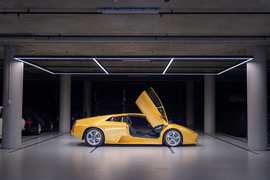
The Aventador is characterized by its aggressive, angular design, which seems to defy the laws of conventional automotive aesthetics. Its low-slung profile, scissor doors that swing upward in a dramatic display, and sharp, faceted bodywork make it instantly recognizable. This is a car that demands attention, a rolling sculpture that is as much a work of art as it is a mode of transport.

At the heart of the Aventador lies a naturally aspirated 6.5-liter V12 engine, a powerplant that has become the signature of Lamborghini’s flagship models. In the Aventador S, this magnificent engine produces 740 horsepower, driving all four wheels through a sophisticated all-wheel-drive system. The transmission