
Title: The Pinnacle of Automotive Extravagance: An Expert’s Guide to the World’s Most Expensive Cars
In the rarefied atmosphere of the global automotive market, certain vehicles transcend their utilitarian purpose to become rolling monuments to wealth, engineering prowess, and artistic expression. These are not merely modes of transportation; they are icons, objets d’art, and often, the ultimate status symbols for the world’s elite. For enthusiasts and industry veterans alike, the question isn’t just “what is the most expensive car?” but rather, “what does it take to create a machine that commands such staggering valuations in 2025?”
Having spent a decade immersed in the high-end automotive sector, navigating auction results, factory tours, and exclusive collector events, I’ve witnessed firsthand the evolution of what constitutes “expensive.” The landscape has shifted dramatically. While the hypercars of the early 2010s focused purely on horsepower and top speed, today’s multi-million-dollar machines emphasize bespoke craftsmanship, sustainable luxury materials, and seamless technological integration. The secondary market, driven by scarcity and heritage, now regularly sees vintage icons shattering auction records, proving that history holds as much value as horsepower.

This comprehensive guide will delve into the upper echelons of automotive pricing, exploring the vehicles that define the absolute peak of the market. We will analyze the engineering marvels, the historical significance, and the intangible factors that contribute to their astronomical price tags, providing insights that only years of industry experience can offer.
The Zenvo ST1 ($1.2 Million): A Scandinavian Symphony of Power
The Zenvo ST1, hailing from Zealand, Denmark, serves as a potent reminder that hypercar innovation isn’t confined to the traditional automotive powerhouses of Italy or Germany. This machine is less a car and more a declaration of intent, a brute-force symphony of engineering designed to shock and awe. Its creation represents a bold statement by a nation not typically associated with exotic supercar production.
At the heart of the ST1 lies a custom-developed 6.8-liter V8 engine, a marvel of forced induction engineering. Zenvo’s engineers opted for a dual-charging strategy, employing both a centrifugal supercharger and a turbocharger to feed the massive cylinders. This combination is designed to eliminate the traditional trade-offs between low-end torque and high-end power delivery. The result is an absolutely obscene power output: 1,104 horsepower and a staggering 1,054 pound-feet of torque, all channeled exclusively to the rear wheels.
Driving the ST1 is an experience akin to harnessing a wild animal. The immediate surge from the supercharger provides instant throttle response, while the turbocharger spools up to deliver a relentless wave of acceleration that pushes the driver deep into the bespoke carbon-fiber seat. The gearbox, a bespoke seven-speed unit, manages this colossal torque with precision, though the visceral nature of the power delivery remains the star of the show.
The exterior design is equally dramatic, featuring aggressive aerodynamics, large air intakes, and a commanding road presence. It is a car that demands attention, its sharp lines and muscular stance ensuring that it stands out even in a field of hypercars. The interior, while luxurious, is driver-focused, eschewing unnecessary frippery for high-quality materials and intuitive controls.
While the ST1’s performance figures place it firmly in the realm of elite hypercars, its true value lies in its exclusivity and the audacious spirit of its creators. In a market increasingly dominated by hybrid powertrains and automated driving systems, the Zenvo ST1 stands as a bastion of raw, mechanical engagement. It is a testament to the idea that sometimes, the most compelling automotive statements are those delivered with unbridled power and unapologetic intent.
The Ferrari LaFerrari ($1.4 Million): A Hybrid Masterpiece
When Ferrari embarks on a “LaFerrari” project—the name itself translating to “The Ferrari”—it signifies more than just a new model; it represents the pinnacle of the company’s technological prowess and design philosophy at that moment in time. The LaFerrari, launched in 2013, was a watershed moment, marking the Italian marque’s bold embrace of hybrid technology for its flagship hypercar.
The decision to integrate a hybrid system was revolutionary for Ferrari, a company traditionally associated with naturally aspirated V12 engines and pure driving purity. Yet, the LaFerrari proved that hybridization could enhance, rather than detract from, the driving experience. The car combines a potent 6.3-liter naturally aspirated V12 engine with an electric motor and a KERS (Kinetic Energy Recovery System), similar to those used in Formula 1.
This synergistic powertrain produces a combined output of approximately 950 horsepower and 700 pound-feet of torque. The electric motor fills the torque gaps inherent in the V12’s power band, providing instant acceleration from a standstill. As a result, the LaFerrari rockets from 0 to 60 mph in less than 3.0 seconds, reaching 124 mph in under 7 seconds. Top speed is electronically limited to 217 mph, though the car’s aerodynamic efficiency suggests it could achieve higher velocities.
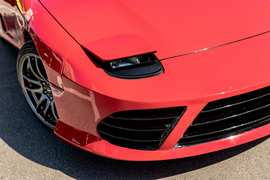
Beyond the staggering performance figures, the LaFerrari is a visual tour de force. Its design language, penned by Flavio Manzoni at the Ferrari Styling Centre, is a masterclass in aerodynamic optimization and aesthetic drama. The bodywork features aggressive curves, intricate ducting, and a low-slung, predatory stance that seems to slice through the air even when stationary. The active aerodynamics, including front and rear spoilers that adjust automatically, ensure optimal downforce and stability at high speeds.
Inside, the cockpit is a driver-focused sanctuary, blending race-car functionality with Italian luxury. The seats are integrated into the carbon-fiber chassis, providing a secure and immersive driving position. Materials such as Alcantara, carbon fiber, and brushed aluminum are used extensively, creating an atmosphere of exclusive performance.
The significance of the LaFerrari extends beyond its technical achievements. It symbolized Ferrari’s commitment to a sustainable yet thrilling future, proving that hybrid technology could be the key to unlocking unprecedented levels of performance. In the years since its introduction, the LaFerrari has become one of the most sought-after models in Ferrari’s history, with prices in the secondary market continuing to climb, reflecting its status as a landmark vehicle in the evolution of the supercar.
The Pagani Huayra ($1.4 Million): The God of Winds
Horacio Pagani, the visionary founder of Pagani Automobili, has long been revered in automotive circles not just as a manufacturer, but as an artist who happens to work with carbon fiber and titanium instead of clay and bronze. The Huayra, successor to the legendary Zonda, is perhaps the purest expression of his philosophy, a machine where obsessive attention to detail meets breathtaking performance.
The name “Huayra” (pronounced “why-rah”) itself pays homage to the Incan God of Winds, a fitting moniker for a car designed to master the air. This automotive sculpture is powered by a bespoke 6.0-liter V12 engine sourced from AMG, Pagani’s long-time technical partner. Unlike many modern hypercars that rely on complex turbocharging systems, the Huayra’s V12 features two turbochargers, carefully calibrated to deliver a smooth, linear power band that mimics the responsiveness of a naturally aspirated engine.
The specifications are remarkable: 620 horsepower and a massive 740 pound-feet of torque. This power is channeled through a lightweight, seven-speed sequential gearbox—an engineering marvel in its own right—to the rear wheels. The combination of the potent V12 and the sophisticated transmission allows the Huayra to accelerate with savage intensity, capable of reaching 60 mph in under 3.0 seconds and topping out at speeds approaching 230 mph.
However, the Huayra’s true magic lies in its craftsmanship and aerodynamics. Every curve of the bodywork, every vent and duct, has been meticulously sculpted to manage airflow with surgical precision. The car features active aerodynamic elements, including front and rear spoilers that adjust independently to optimize downforce and braking performance. This complex ballet of air management ensures that the Huayra remains planted and stable at any speed, making it both a thrilling and confidence-inspiring machine to drive.
The interior is a testament to Pagani’s artisanal approach. Stepping inside the Huayra is akin to entering a bespoke atelier. The cabin is a symphony of luxurious materials, with hand-stitched leather, polished aluminum switchgear, and exposed carbon fiber panels creating an ambiance of refined opulence. The central control console, resembling a high-end watch movement, is a work of art in itself, featuring an array of beautifully crafted dials and levers that invite interaction.
The Huayra is not merely a fast car; it is a sensory experience. The sound of the V12 engine, the feel of the controls, the visual drama of the active aerodynamics—all combine to create a driving experience that is deeply engaging and emotionally resonant. In a world of increasingly homogenized automotive design, the Pagani Huayra stands out as a testament to the enduring power of individuality, artistry, and engineering excellence.
The Aston Martin One-77 ($1.4 Million): The British Bulldog’s Ultimate Expression

The Aston Martin One-77 is a name that evokes a sense of rarity, power, and quintessentially British elegance. Produced in extremely limited numbers—just 77 examples were built—this car represents the zenith of Aston Martin’s engineering capabilities and design philosophy. It is a vehicle that commands attention not through ost