
Title: The Pantheon of Automotive Excess: A Deep Dive into the World’s Most Expensive Cars
Introduction: The Allure of the Hypercar
In the rarefied atmosphere where the pursuit of performance intersects with the zenith of human engineering, we find the world’s most expensive cars. These are not merely modes of transportation; they are rolling sculptures, rolling statements of intent, and rolling testaments to the fact that when money is no object, the constraints of practicality are jettisoned entirely. For the elite one percent, these machines represent the ultimate expression of power, status, and a passion that borders on the obsessive.

The psychology behind acquiring such a vehicle is fascinating. It speaks to a desire for exclusivity—owning something so rare that it exists in a category of one. It also reflects an appreciation for artistry. When you examine the construction of a Bugatti or a Pagani, you are looking at hundreds of hours of meticulous handcraftsmanship. Every carbon fiber weave, every leather stitch, every milled aluminum component tells a story of dedication and skill that few possess the means to commission.
But let us dispense with the sociology and dive into the mechanical marvels themselves. We are going to explore a curated selection of the most breathtaking, jaw-dropping, and wallet-obliterating automobiles ever conceived. We will delve into the engineering minutiae that make them outliers on the road and the design philosophies that set them apart. Prepare to have your breath stolen, your expectations shattered, and your understanding of what a car can be fundamentally recalibrated. This is the definitive countdown of automotive excess.
The Zenvo ST1: A Danish Powerhouse Reimagined
Our journey into the upper echelons of automotive luxury begins in Zealand, Denmark, with a car that defies convention and logic in equal measure: the Zenvo ST1. This is not a car that was born from a committee; it is the brainchild of a visionary who dared to dream of a hypercar crafted entirely on Danish soil. The result is a machine that is as uncompromising as its homeland is stoic.
The ST1’s claim to fame lies in its audacious powertrain. Zenvo engineers eschewed the common path of utilizing a conventional engine setup. Instead, they took a robust 6.8-liter V8 and subjected it to a dual-induction regimen, bolting on both a supercharger and a turbocharger. This combination is not merely for show; it is a Symphony of forced induction designed to extract every last molecule of performance from the powerplant.
The numbers are, frankly, staggering. The ST1 churns out a colossal 1,104 horsepower and 1,054 pound-feet of torque. To put this into perspective, this is power levels usually reserved for top-tier drag racers or specialized track machines. Yet, Zenvo managed to package this immense force into a road-legal chassis, complete with luxury amenities. The power is sent exclusively to the rear wheels, making the ST1 a driver’s car in the truest sense of the word—a machine that demands respect and skill to master.
The exterior design of the ST1 is a masterclass in aggressive aerodynamics. It features sweeping lines that are both beautiful and functional, with large vents and spoilers designed to manage the prodigious airflow required to cool the engine and keep the car planted at speed. The interior is equally impressive, finished in premium leather and Alcantara, with carbon fiber accents that remind the driver of the car’s sporting pedigree.
However, the Zenvo ST1 is not without its eccentricities. It famously features a dashboard design that includes a pull-out cupholder, a feature that seems almost comically mundane in a car that can accelerate to 60 mph in under three seconds. This juxtaposition of the sublime and the practical is part of the Zenvo’s charm. It is a car that does not take itself too seriously, even as it delivers world-beating performance. It is a statement that the Danes can play in the same sandbox as the Italians and the Germans, and they can do it with their own unique brand of flair.
The Ferrari LaFerrari: Hybrid Power Meets Italian Soul
When you hear the name Ferrari, you expect a certain level of performance, a certain aesthetic, and a certain sound. The LaFerrari delivers on all fronts, and then some. This hybrid hypercar is arguably one of the most important cars in Ferrari’s recent history, marking the brand’s first foray into gasoline-electric hybrid technology for a production model. It is a car that proves that environmental consciousness and exhilarating performance can coexist harmoniously.
The engineering behind the LaFerrari is nothing short of revolutionary. Ferrari engineers took their already potent 6.3-liter V12 engine, a powerplant that produces a healthy 789 horsepower on its own, and mated it with an electric motor system derived from their Formula 1 KERS (Kinetic Energy Recovery System). This HY-KERS system adds an additional 160 horsepower to the total output, bringing the car’s combined power to a breathtaking 949 horsepower.

The acceleration of the LaFerrari is the stuff of legends. With a dry weight of less than 2,800 pounds, the car rockets from 0 to 60 mph in a mere 2.9 seconds. It reaches 124 mph in under seven seconds, and its top speed is electronically limited to 217 mph. But the LaFerrari is not just about straight-line speed. Its advanced aerodynamics and chassis technology make it an absolute weapon on the track, capable of generating lateral forces that would leave most drivers breathless.
Visually, the LaFerrari is a masterpiece of automotive design. It looks less like a car and more like a predatory animal ready to pounce. The low-slung body, the aggressive front splitter, and the sweeping rear diffuser all contribute to its menacing presence. The dihedral doors, which open upwards and forwards, add a touch of drama and theatricality that is quintessentially Ferrari.
Inside, the cockpit is a driver-focused environment, reminiscent of a Formula 1 car. The seats are deeply bolstered to hold the occupants in place during high-G maneuvers, and the steering wheel is a marvel of ergonomic design, featuring integrated controls for various vehicle functions. The materials used throughout the cabin are of the highest quality, with carbon fiber, Alcantara, and premium leather creating an atmosphere of understated luxury.
The LaFerrari is more than just a car; it is a statement of intent. It proved to the world that Ferrari was willing to embrace new technologies to stay ahead of the curve, without sacrificing the passion and performance that define the brand. It is a hybrid that does not feel like a compromise, but rather an evolution of the species. And for those lucky enough to own one, it is a ticket to a driving experience that is nothing short of extraordinary.
The Pagani Huayra: A Masterpiece of Aerodynamics and Artistry
When Enzo Ferrari created his legendary automotive empire, he famously declared that if you build a beautiful car, it will sell itself. Horacio Pagani, the visionary founder of Pagani Automobili, seems to have taken this philosophy to heart and amplified it to an art form. The Huayra, pronounced “why-rah,” is not just a hypercar; it is a rolling sculpture, a testament to the fact that automotive engineering can indeed be elevated to the level of fine art.
The name itself is evocative, derived from the Quechuan word for “wind,” a nod to the car’s remarkable aerodynamic capabilities. The Huayra is a symphony of curves and vents, a flowing design that seems to defy the laws of physics. But its beauty is not merely skin deep. Beneath the exquisitely crafted bodywork lies a powertrain that is equally impressive.
Pagani chose to partner with Mercedes-AMG for its engine needs, a decision that has paid dividends in terms of both performance and reliability. The Huayra is powered by a bespoke 6.0-liter twin-turbocharged V12 engine, an AMG-sourced unit that has been specially developed for this application. This powerplant produces a formidable 620 horsepower and a colossal 738 pound-feet of torque, ensuring that the Huayra has the muscle to match its breathtaking looks.
One of the most striking features of the Huayra is its active aerodynamics. The car is equipped with four individually controlled flaps, two at the front and two at the rear, which can adjust independently to optimize the car’s aerodynamic balance. This system allows the Huayra to generate massive downforce when needed, for example during high-speed cornering, and then reduce drag on the straights to maximize its top speed. It is a level of aerodynamic sophistication that is rarely seen outside of Formula 1.
The interior of the Huayra is perhaps even more impressive than its exterior. Pagani is renowned for its attention to detail, and the Huayra is the culmination of this philosophy. The cabin is a work of art, finished in a combination of premium leather, carbon fiber, and polished aluminum. The switchgear is particularly noteworthy, with each button and dial meticulously crafted to feel substantial and luxurious. The central console is dominated by a digital display that provides the driver with all the necessary information, while the exposed gearbox mechanism adds a touch of mechanical theater.
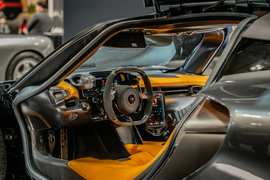
The Huayra is a car that demands to be driven, and when it is, it rewards the driver with an experience that is nothing short of sublime. The engine note is a glorious cacophony of turbo whooshes and mechanical symphony, while the car’s handling is precise and communicative. It is a car that makes the driver feel connected to the road in a way that few other vehicles can match. The Pagani Huayra is a testament to the fact that passion