
The 10 Most Expensive Cars in the World: A Deep Dive into Hypercar Opulence
While most of us navigate the complexities of car finance for a standard hatchback, the world’s ultra-wealthy make multi-million dollar decisions on hypercars without a second thought. These discerning buyers often find vehicles like the Rolls-Royce Phantom or Ferrari 12Cilindri too commonplace, instead seeking bespoke, unique creations produced in strictly limited numbers. They are willing to pay astronomical prices—many times the cost of a marque’s standard offerings—for automotive exclusivity.
This echelon of vehicle is beyond the reach of lottery winners and is reserved exclusively for the billionaire elite. These are the 10 most expensive cars in the world, representing the pinnacle of automotive engineering, luxury, and design.
Bugatti Divo – $5.8 million
For those who find the standard Bugatti Chiron insufficient, the Divo offers a coachbuilt experience purported to be even more thrilling to drive. Named after the French-Italian racing driver Albert Divo—an air force pilot and mechanic who became a Bugatti works driver in 1928 and immediately won the legendary Targa Florio race—the Divo pays homage to his racing heritage.
The car utilizes the Chiron’s 8.0-liter quad-turbo W16 engine, producing 1,479 bhp. Its 0-62 mph time is quoted at 2.4 seconds, though its top speed is capped lower than the standard Chiron’s at ‘only’ 236 mph. This limitation is intentional, as the Divo eschews the ‘Top Speed’ mode in favor of enhanced aerodynamic grip provided by a 1.8-meter wide fixed rear wing, a larger front spoiler, bigger side skirts, and wider air intakes.
To distinguish it from the standard Chiron, the Divo features new headlamps and taillights, along with a wider iteration of Bugatti’s signature ‘horseshoe’ grille. Only 40 Divos were produced, and they sold out on the first day of ordering. Customers were granted almost infinite personalization options, ensuring no two examples are identical.
Pagani Huayra Imola Roadster – $6.2 million
Pagani’s most affluent customers are typically directed toward its ‘Grand Complications’ division, a specialized department dedicated to creating ultra-limited production special projects. The Imola Roadster is one such product, with just eight units manufactured, each featuring a unique specification chosen by its new owner.
Named after the Italian circuit where the chassis was fine-tuned, it boasts a tweaked version of Pagani’s AMG-sourced twin-turbo V12, delivering 838 bhp. Power is sent exclusively to the rear wheels through a seven-speed sequential gearbox. The top speed is electronically limited to 217 mph, or 350 km/h for the metric-inclined.
Despite these formidable figures, the car is exceptionally lightweight compared to rivals like the Bugatti Chiron, tipping the scales at 1,260 kg—less than a modest sedan. However, its massive spoilers generate an additional 900 kg of downforce at track speeds, effectively gluing the Imola to the road surface during high-speed cornering.
The significant weight savings are largely attributable to the use of exotic composites, including the impressive-sounding Carbo-Titanium HP62-G2 and Carbo-Triax HP62. These materials are touted for their exceptional stiffness, contributing significantly to the Pagani’s agile handling characteristics.
Pagani Huayra Codalunga – $7.4 million
While the name might evoke images of marine life or cartoon catchphrases, the Codalunga has a far more compelling narrative. Two collectors approached Horacio Pagani requesting a ‘long-tail’ version of the Huayra Coupé, inspired by the aerodynamic aesthetics of Le Mans racers from the 1960s. Beyond their visual appeal, these elongated, tapering shapes were designed to optimize aerodynamic efficiency.
After two years of design refinement in collaboration with the clients, the car was finally unveiled. All examples feature neutral color schemes and matte paints, with interiors finished in woven leather upholstery and aluminum components precision-machined from single blocks of material. The quad-pipe exhaust, also a nod to classic Le Mans machines, is ceramic-coated for a distinctive finish.
Similar to the Imola, the Codalunga utilizes the AMG-built twin-turbo 6.0-liter V12 engine, tuned here to produce 829 bhp, resulting in a top speed of 217 mph. Beyond the initial two buyers, a further three cars were subsequently built. All five examples are fully homologated for use on public roads, though one might question the wisdom of sharing space with conventional traffic in such a machine.
Mercedes-Maybach Exelero – $8 million
Imagine approaching your supervisor with the request for a new vehicle solely for tire testing purposes. It needed to be large, heavy, and fast. Instead of selecting an existing super saloon, the owners of Fulda—Goodyear’s German subsidiary—commissioned a one-off coupe from Maybach at a cost of $8 million.
The company had executed a similar project in 1938, resulting in the Maybach SW38, which achieved a remarkable top speed of 125 mph for its era. That vehicle was tragically lost during World War II, but its spirit and ‘streamliner’ styling cues live on in the Exelero.
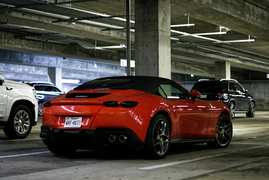
The 2.6-tonne car features only two seats yet measures an imposing 5,834 mm in length—exceeding the dimensions of a Rolls-Royce Phantom. This extensive wheelbase allowed for an extraordinarily long bonnet, reputedly large enough to host a tennis match. Beneath it resides a V12 engine, enlarged from the standard Maybach’s 5.6-liters to 5.9-liters and augmented with twin turbos to boost output to 691 bhp. Its claimed top speed is 217 mph.
The Exelero has made appearances in various films and television shows, and there were persistent rumors that it had been acquired by a prominent rapper. However, it remains on display in a German museum.
Bugatti Centodieci – $9 million
For billionaire Bugatti collectors, the anticipation for a new model that paid homage to the classic EB110 Supersport from the mid-1990s was palpable. That wait concluded in 2019 with the unveiling of the Centodieci—a Chiron-based coupe designed as a modern interpretation of the EB110 and a celebration of the company’s 110th anniversary.
It presents a surprisingly distinct profile compared to the standard Chiron, featuring an entirely new roofline, a lower front fascia, and a rear section that sits significantly higher. The Bugatti horseshoe grille is notably smaller, echoing the EB110’s design, complemented by five round air intakes arranged in a diamond pattern and a long glass engine cover.
Mechanically, it shares the Chiron’s architecture, with the 8.0-liter W16 engine producing 1,578 bhp, propelling the Centodieci from 0 to 62 mph in 2.4 seconds. Its top speed is limited to just under 240 mph, and the chassis has been retuned to deliver an even sportier driving experience.
Only 10 examples were handcrafted, and every unit was sold before production commenced, commanding a unit price of €8 million.
Bugatti Chiron Profilée – $10.8 million
One of the inherent risks for affluent collectors is the possibility of encountering another billionaire parked outside a local supermarket in the identical vehicle—a scenario fraught with potential embarrassment. To mitigate this, the ultimate solution is exclusivity: a one-off creation.
This is precisely the premise behind the Chiron Profilée, although it was not initially conceived for a specific customer. Instead, the car was developed in response to several collectors who expressed a desire for a Chiron that combined the performance and handling enhancements of the track-focused Pur Sport with a more road-biased character. Bugatti commenced development but soon realized that mass production would be impossible, as the Chiron production run was strictly limited to 500 vehicles, all of which were accounted for.
Consequently, only one Profilée was ever constructed. Adding to its unique status, the car serves as the final Bugatti to feature the W16 engine and holds the distinction of being the fastest-accelerating of all Chiron models, achieving a 0-62 mph time of 2.3 seconds.
Rolls-Royce Sweptail – $13 million
When most consumers select a new vehicle, they might indulge in a few optional extras, such as metallic paint or a sunroof, potentially adding a few hundred dollars to the total cost. However, when a Hong Kong-based businessman decided to commission a Rolls-Royce Phantom Coupé, he opted for a bespoke body and interior, drawing inspiration from luxury yachts and classic coachbuilt Rolls-Royce models from the 1920s and 30s.
Rolls-Royce dedicated four years to its construction, resulting in a price tag of $13 million—equivalent to the cost of 22 standard Phantom Coupés. This made it the world’s most expensive car upon its reveal in 2017.
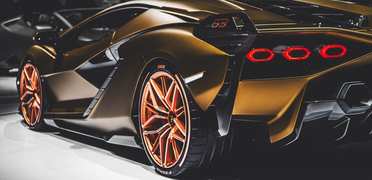
Its most distinguishing feature is the elongated, tapering tail, crowned by a panoramic glass roof—one of the largest and most complex ever integrated into an automobile. This feature allows for an unobstructed view of the interior, which is trimmed in two-tone leathers for