Title: The Pinnacle of Automotive Opulence: Exploring the World’s Most Expensive Cars in 2026
The automotive landscape of 2026 is a study in contrasts. On one hand, we see the democratization of mobility, with advanced driver-assistance systems becoming standard and electric vehicle technology making high performance accessible to a broader audience. Yet, at the zenith of this industry, an elite echelon of vehicles exists that defies conventional economics. For the world’s ultra-high-net-worth individuals, the concept of “value” is measured not in miles per gallon or practicality, but in exclusivity, bespoke craftsmanship, and the sheer audacity of engineering. This is the realm where cars transcend transportation and become rolling sculptures, investment-grade assets, and the ultimate symbols of status.
The assertion that “new cars are too expensive these days” holds a certain truth for the average consumer, where the price of a mainstream sedan has indeed climbed, largely in lockstep with inflation and the integration of sophisticated technology. However, this perspective dissolves when one considers the clientele for whom money is no object. With the global population of millionaires and billionaires continuing to swell, the demand for vehicles that are not merely luxurious, but utterly unique, has never been higher. In this exclusive stratosphere, the rules of the market are rewritten, and the price tags attached to these mechanical marvels reflect a confluence of artistic vision, engineering prowess, and unparalleled rarity.

This in-depth exploration delves into the pantheon of the world’s most expensive cars, dissecting the elements that elevate these machines from mere automobiles to legendary artifacts. We will traverse the globe, from the artisanal workshops of Italy to the bespoke houses of the United Kingdom, uncovering the stories behind the most extravagant expressions of automotive desire. Prepare to have your perception of automotive value redefined as we navigate the exclusive world of the hyper-expensive.
Bugatti Divo: The Track-Focused Hyper-Elegance
At number ten on our list, we find the Bugatti Divo, a machine that serves as a testament to the French marque’s enduring legacy of exclusivity and performance. Priced at approximately $5.8 million (£4.4 million), the Divo is not merely a derivative of the already formidable Bugatti Chiron; it is a calculated reimagining of its capabilities, tailored for the discerning collector who demands more than outright speed.
The Divo’s genesis lies in the desire to create a vehicle that prioritizes agility and aerodynamic downforce over the Chiron’s singular focus on top speed. With only 40 examples ever slated for production, the Divo immediately assumes a position of extreme rarity. This scarcity is a critical factor in its valuation, ensuring that its owners are part of an infinitesimal club of automotive connoisseurs.
Mechanically, the Divo retains the heart of the Chiron—the iconic 8.0-liter quad-turbocharged W16 engine. However, Bugatti’s engineers re-tuned this behemoth to deliver a slightly different character, focusing on mid-range torque delivery and throttle response. The result is an astonishing 1,479 horsepower, channeled through an all-wheel-drive system that ensures the car’s immense power is translated into blistering acceleration. Yet, the Divo’s true brilliance lies in its chassis. Extensive modifications, including revised suspension geometry, a fixed rear wing that generates 90 kilograms more downforce than the Chiron’s active spoiler, and a reduced top speed limited to 236 mph (ironically, a feature that enhances its track capability), transform the driving experience.
From a design perspective, the Divo is a masterclass in coachbuilding. Its bodywork is a symphony of carbon fiber, sculpted to manage airflow with surgical precision. The front fascia is more aggressive, featuring larger air intakes and a distinctive C-shaped motif that nods to Bugatti’s heritage. The rear is perhaps the most dramatic departure, dominated by a complex, multi-element wing and a diffuser that hints at the car’s racing pedigree.
The interior is a sanctuary of bespoke luxury, though executed with a sporting intent. Bugatti eschews excessive ornamentation in favor of premium materials like Alcantara, carbon fiber, and supple leather. The color palette is often bold, with contrasting stitching and accents that emphasize the car’s dual personality—a creature of both track and boulevard.
The Divo’s value proposition extends beyond its mechanical and aesthetic attributes. It represents a specific chapter in Bugatti’s modern history, a bridge between the Chiron era and the company’s evolving focus on even more exclusive, coachbuilt projects. For collectors, owning a Divo is akin to possessing a piece of automotive art that is both viscerally thrilling and historically significant.
Pagani Huayra Imola Roadster: The Uncompromising Italian Artistry
Venturing further into the rarefied atmosphere of automotive hyper-exclusivity, we arrive at the ninth position, occupied by the Pagani Huayra Imola Roadster. This extraordinary machine commands a price tag of approximately $6.3 million (£4.7 million), a figure that reflects its status as a product of one of the most artisanal manufacturers in the world. Pagani, under the visionary leadership of Horacio Pagani, has built a global reputation for creating vehicles that blur the lines between engineering and art, and the Imola Roadster is a prime example of this philosophy.
The Huayra platform itself is legendary, but the Imola Roadster represents a specific, no-compromise iteration. The name “Imola” pays homage to the Enzo e Dino Ferrari International Circuit, a historic venue synonymous with Italian motorsport prowess. This designation is not merely symbolic; it signifies the car’s ultimate purpose: track dominance.
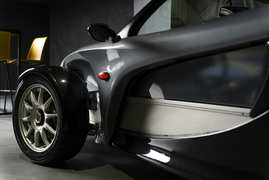
Unlike mass-produced hypercars, the Imola Roadster is a product of Pagani’s Grandi Complicazioni division, the company’s bespoke atelier responsible for creating the most elaborate and technically demanding projects. This ensures that each of the limited production run—reportedly just eight units—is a unique expression of the owner’s desires, tailored with a level of personalization that is simply unattainable in more conventional high-performance vehicles.
At the heart of the Imola Roadster beats a powerplant that is a testament to Pagani’s long-standing partnership with Mercedes-AMG. The bespoke 6.0-liter twin-turbocharged V12 engine has been extensively re-engineered for this application, producing a staggering 838 horsepower. This prodigious output is delivered through a sophisticated seven-speed automated manual transmission, a unit renowned for its rapid shifts and mechanical precision.
However, the Imola Roadster’s extraordinary value is not solely attributable to its engine. The car’s chassis is a masterwork of advanced materials science. Extensive use of carbon fiber, carbon-titanium composites, and aerospace-grade alloys has resulted in a remarkably low curb weight, despite the inclusion of significant aerodynamic enhancements. This lightweight construction is crucial to the car’s dynamic capabilities, allowing it to exploit its power with an agility that belies its size.
The aerodynamic package is nothing short of breathtaking. A substantial fixed rear wing generates an estimated 900 kilograms of downforce at high speeds, pressing the car onto the tarmac and ensuring relentless grip during high-velocity cornering. The bodywork is a complex tapestry of scoops, wings, and vanes, each element meticulously sculpted to manage airflow, cool the mechanical components, and enhance stability.
The interior of the Imola Roadster is a sensory immersion. Pagani’s approach to cabin design is theatrical yet refined. The cockpit is a celebration of exquisite materials, featuring hand-stitched leather, polished aluminum accents, and exposed carbon fiber that serves as a constant reminder of the car’s high-tech construction. The driving position is intimate and focused, with a wraparound dashboard that cocoons the driver, fostering a deep connection between man and machine.
The scarcity of the Imola Roadster further solidifies its position among the world’s most expensive cars. With only eight examples planned, the opportunity to acquire one is limited to an elite circle of collectors who value not just the driving experience, but the prestige of owning a piece of automotive history that few will ever witness, let alone experience.
Pagani Huayra Codalunga: The Evocation of Le Mans Endurance Racers
Continuing our journey through the zenith of automotive exclusivity, we encounter the eighth most expensive car on the list: the Pagani Huayra Codalunga. This exceptional machine commands a price of approximately $7.4 million (£5.9 million), representing another pinnacle of Pagani’s bespoke engineering prowess. The Codalunga, which translates to “long tail” in Italian, is a homage to the legendary endurance racers of the 1960s, a concept born from the imaginations of two particularly ambitious collectors.
The genesis of the Codalunga is a compelling illustration of how Pagani’s bespoke division operates. Two devoted clients approached Horacio Pagani with a specific vision: a long-tail version of the already formidable Huayra, inspired by the dramatic silhouettes of vintage Le Mans prototypes. This request was not simply about extending the car’s bodywork; it was about encapsulating the spirit of a bygone era of motorsport while integrating the most advanced technologies of the modern age.
The most striking feature of the Codalunga is, as its name suggests, its elongated rear section. Stretching an additional 36 centimeters beyond that of the standard Huayra, the rear deck sweeps gracefully towards the horizon, evoking the aerodynamic efficiency of the classic racers that once dominated the French circuit. This extension serves a dual purpose: it enhances aerodynamic stability at high speeds and creates a visually stunning silhouette that distinguishes the Codalunga from its siblings.

Beneath the sculpted bodywork lies a powertrain that represents the culmination of years of development. The Huay