🔻 WATCH FULL VIDEO BELOW 🔻

14 Cars That Ignited the Horsepower Wars
Today, we take power and speed for granted. Any supercar that doesn’t boast at least 600 horsepower (441 kW) is simply not worth its asking price. Similarly, many mainstream performance electric vehicles can now sprint from 0 to 100 km/h in under four seconds—a feat that was once reserved for the most advanced and exclusive hypercars. This isn’t just a recent development; the relentless march of progress has been unfolding for decades, most notably in what’s known as the “horsepower wars.”
This ongoing battle among manufacturers has seen a consistent drive over the last 30 years to one-up each other’s performance figures. The result? A landscape featuring 400-horsepower (294 kW) hot hatches, 600-horsepower (441 kW) luxury sedans, and 800-horsepower (588 kW) hypercars. Along the way, several pivotal moments have punctuated this race for supremacy. We’ve decided to chronicle some of the most significant contenders, though it must be said that true game-changers at the very top end of the spectrum are few and far between.
Lotus Carlton: The Sleeper That Alarmed a Nation
Few cars in history have prompted such intense debate about the very legality of their power output as the Lotus Carlton. This British icon arguably defined the concept of a “sleeper”—a car whose unassuming appearance belied its blistering performance. While it certainly wasn’t subtle, with its aggressive front splitter, wide arches, and prominent rear wing, even these modifications couldn’t fully prepare the world for what lay beneath.
Lotus engineers took the Vauxhall Carlton’s six-cylinder engine and subjected it to a twin-turbocharging regimen. The result was a staggering 382 horsepower (280 kW) and a top speed of 280 km/h (177 mph). In 1990, this was simply mind-blowing. For context, the contemporary BMW M5 produced 315 horsepower (231 kW), and the Porsche 911 Turbo offered 320 horsepower (235 kW). The Carlton was in a different league entirely. It was the first time many enthusiasts and industry observers had to seriously question whether such accessible levels of power were actually a good thing.
Ford Focus RS: The Hot Hatch Benchmark is Redefined
In the 1980s and ’90s, the pinnacle of hot hatch performance was measured in the low 200s horsepower-wise. Models like the Golf GTI, 205 GTI, and Clio Williams delivered thrilling driving experiences to the masses. So, how did we end up with hot hatches boasting double that power just 30 years later? It happened gradually, punctuated by key moments, one of the most significant being the 2002 Ford Focus RS.
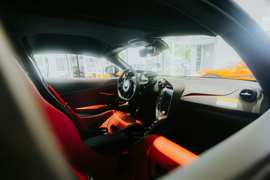
While the Escort Cosworth had previously pushed boundaries, it was a niche, four-wheel-drive special. The Focus RS, on the other hand, set the template for the decade-long horsepower battle in the hot hatch segment. It featured a turbocharged four-cylinder engine producing 215 horsepower (158 kW), driving the front wheels—the traditional layout for a hot hatch. Performance upgrades were equally significant, including a Quaife torque-biasing limited-slip differential to manage the power. The RS was an unapologetic, characterful machine, remembered for its raw, feisty personality.
Honda S2000: A Masterclass in High-Revving Ingenuity
The Honda S2000 may not have stood out for outright horsepower figures, but it represents a critical milestone in the story of engine efficiency and power density. Its 2.0-liter, naturally aspirated, dual-overhead-cam, inline-four engine (F20C) produced 250 horsepower (183 kW) and could rev to an astonishing 9,000 rpm.
More importantly, it achieved an output of 125 horsepower (91 kW) per liter—a benchmark that stood for a decade. It wasn’t until the Ferrari 458 Italia in 2009 and the Porsche 911 GT3 in 2013 that this figure was surpassed. To this day, the S2000 retains its place among the highest-revving naturally aspirated production cars ever made, sharing company with automotive legends like the Ferrari LaFerrari, Porsche 918 Spyder, GMA T.50, and Aston Martin Valkyrie. This achievement underscores Honda’s engineering prowess during that era.
Mercedes-Benz CL65 AMG: V12 Power Reaches New Heights
When the objective is sheer, unadulterated power, engine displacement combined with forced induction remains the most effective formula. This is precisely why the Mercedes-Benz CL65 AMG, introduced in 2003, commanded attention with its colossal 612 horsepower (450 kW).
Thanks to a 6.0-liter, twin-turbocharged V12 engine, it was easily the most powerful series-production (non-limited edition) road car in the world at the time. This level of power was on par with supercar territory back then. In truth, it was almost too much for the road, as evidenced by the frantic efforts of the traction control system every time the driver attempted to deploy the full force of that V12 to the rear wheels. The CL65 AMG truly excelled at high-speed cruising, capable of dispatching the 70-140 mph increment with the same ferocious urgency most performance cars exhibit when accelerating from a standstill.
Bugatti Veyron: Redefining the Hypercar
It’s impossible to discuss the history of the horsepower race without acknowledging the Bugatti Veyron. From its inception, the Veyron represented the absolute zenith of engine power. While its successors have pushed well beyond the 1,600 horsepower (1,176 kW) mark, the Veyron’s original 1,000 horsepower (735 kW) output in 2005 sent a clear message to the entire automotive world: there were no longer any limits to what was possible.
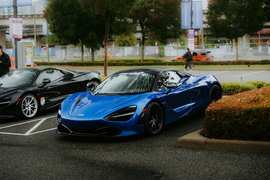
The engineering feat of the Veyron was monumental, costing Volkswagen Group a fortune that even the subsequent Chiron (which, to be fair, utilized a heavily evolved version of the same engine) likely couldn’t fully recoup. Even after years in production, the Veyron’s specifications remain astonishing: an 8.0-liter, 16-cylinder engine with four turbochargers. It was, and in many ways remains, a true outlier.
BMW M5: The Quintessential Performance Sedan Evolves
The BMW M5 has long been a central figure in the horsepower wars. However, the escalating rivalry between BMW and Mercedes-Benz to increase power outputs reached a crescendo in 2004 with the launch of the E60 M5. Abandoning the previous generation’s formula, BMW equipped this new M5 with a 5.0-liter, naturally aspirated V10 engine.
Remarkably, by simply adding two cylinders and increasing displacement, BMW managed to extract 100 horsepower more than the E39 it replaced. This was a significant leap, but the headline figure was the 507 horsepower (372 kW). For perspective, it took nearly 15 years for the M5 to gain another 100 horsepower (73 kW), with the 2018 M5 Competition reaching 625 horsepower (459 kW). The E60’s power jump was a defining moment in the evolution of the performance sedan.
Audi RS6: The V10 Powerhouse Redefines the Family Car
While the race to the top was certainly heated, one of the most significant advancements on the road to the modern M5 came from an unlikely source: Audi. Mercedes-AMG had made its move with the E63, but it was the Audi RS6 that delivered the knockout blow to the segment’s established order.
Launched in 2009, the C6 generation RS6 featured a 5.2-liter, twin-turbocharged V10 engine, producing an extraordinary 580 horsepower. This was a remarkable figure for a family car at the time. It represented the final major surge in power for the internal combustion engine in this class, with subsequent models generally fluctuating between 570-625 horsepower (419-459 kW). The RS6 C6 wasn’t without its critics—its two-ton weight and less-than-stellar chassis dynamics were often cited—but it undeniably etched its name in history as a legend of the horsepower wars.
Chevrolet Corvette ZR1: American Power Goes Global
The competitive surge in horsepower wasn’t confined to German manufacturers. Our friends across the Atlantic were certainly not going to be left out of the equation. We thought the C6 Corvette Z06, with its 505 horsepower (371 kW) naturally aspirated V8, was a monster when it debuted in 2006. Then, in 2008, the Corvette ZR1 arrived.
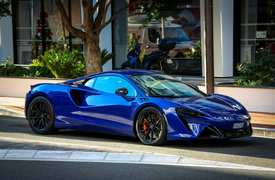
Chevy replaced the Z06’s 7.0-liter LS7 with the 6.2-liter supercharged LS9, unleashing a monumental 647 horsepower (475 kW). This “Blue Devil” Corvette wasn’t just a North American phenomenon; it made waves in Europe, setting N