
The Evolution of the Automotive Elite: A Deep Dive into the World’s Most Exclusive Hypercars
The automotive landscape of the early 2020s has been utterly transformed by a relentless pursuit of the extraordinary. We are living in a golden era where the lines between concept art and production reality have blurred to an astonishing degree. At the zenith of this revolution sit the hypercars—machines that don’t just push the boundaries of performance; they shatter them. These are not mere vehicles; they are rolling sculptures, rolling laboratories, and rolling statements of intent from marques that have defined automotive excellence for generations. For the discerning collector or the passionate enthusiast, understanding the nuances of this exclusive segment is crucial. This comprehensive guide delves into the world’s most elite hypercars, dissecting the technology, design, and engineering prowess that makes them the arbiters of speed and luxury in 2025.
The Genesis of the Hypercar: From Supercars to Stratosphere

Before we ascend to the rarefied air of the hypercar, it is essential to contextualize their origin. The term “hypercar” itself is a relatively recent coinage, emerging to describe a category of vehicles that transcends the already lofty standards of the supercar. A supercar, by definition, is an exotic, limited-production sports car characterized by aerodynamic styling, race-bred engineering, and performance metrics that place them far above conventional automobiles. Think Ferrari, Lamborghini, and McLaren at their most potent.
The hypercar, however, takes these ingredients and amplifies them to an almost unbelievable degree. If a supercar is a Formula 1 car for the road, a hypercar is a spaceship. The defining characteristic is a relentless focus on absolute performance, often prioritizing lap times and top speeds over practicality or comfort. This pursuit has been facilitated by several converging technological trends: the rise of advanced composite materials like carbon fiber, the maturation of hybrid powertrain technology, and the transfer of genuine race-car aerodynamics to road-legal vehicles.
In the early 2020s, the competitive landscape has become fiercer than ever. Traditional giants are being challenged by insurgent brands and boutique manufacturers, each vying to produce the fastest, the most technologically advanced, or the most exclusive machine. This intense rivalry has led to an unprecedented level of innovation, ensuring that the definition of a “hypercar” is constantly being rewritten.
The Aston Martin Valkyrie: A Formula 1 Car for the Road
When one speaks of the intersection of automotive engineering and Formula 1, the Aston Martin Valkyrie immediately comes to mind. Born from a collaboration between the storied British marque and the legendary F1 aerodynamicist Adrian Newey, the Valkyrie is less a car and more a physical manifestation of aerodynamic theory. The name itself, derived from Norse mythology, evokes images of the maidens who choose the slain, hinting at the ruthless efficiency of the machine.
Visually, the Valkyrie is breathtaking and utterly uncompromising. Its design language eschews traditional automotive proportions in favor of a form dictated entirely by airflow. The bodywork is a complex tapestry of scoops, ducts, and wings, sculpted to manage air pressure and generate downforce with surgical precision. The cockpit is a tight, fighter-jet-like enclosure, emphasizing the car’s singular focus on the driving experience.
Underneath the carbon fiber skin lies a powertrain that is nothing short of revolutionary. Developed in partnership with Cosworth, the Valkyrie is powered by a naturally aspirated 6.5-liter V12 engine. This isn’t just any V12; it’s a high-revving masterpiece capable of spinning to an ear-splitting 11,000 rpm. When combined with an electric motor system, the total output exceeds 1,100 horsepower, resulting in a power-to-weight ratio that is simply staggering. The engineering goal was not just speed, but agility. The car’s lightweight construction and advanced suspension system ensure that it handles with the kind of telepathic precision usually reserved for pure track machines. For the collector seeking the purest distillation of F1 technology in a road-legal package, the Valkyrie stands as a towering achievement.
The Bugatti Chiron: The Apex of W16 Engineering
The name Bugatti carries an almost mythical weight in the world of automotive royalty, evoking images of pre-war elegance and post-war resurgence. The Chiron, the successor to the legendary Veyron, represents the modern pinnacle of the marque’s engineering philosophy. It is a car that defies categorization, blending the brutal power of a dragster with the opulent luxury of a grand tourer.
At the heart of the Chiron lies the iconic Bugatti W16 engine. This quad-turbocharged, 8-liter behemoth is a testament to the engineering prowess of the Volkswagen Group, which owns the Bugatti brand. In its most potent iterations, such as the Chiron Super Sport 300+, the W16 pushes out well over 1,500 horsepower. This immense power is channeled through a sophisticated all-wheel-drive system, allowing the Chiron to achieve speeds that were once thought impossible for road cars.
What sets the Chiron apart from its competitors is its duality. While it is capable of mind-bending acceleration—rocketing from 0 to 60 mph in under 2.5 seconds—it is also a remarkably comfortable and refined machine. The interior is a sanctuary of hand-stitched leather, polished aluminum, and bespoke finishes. This blend of raw power and ultimate luxury is the essence of the Bugatti experience. As a symbol of ultimate automotive wealth and engineering achievement, the Chiron remains an icon of the early 2020s.

The Koenigsegg Jesko: Swedish Precision Meets Hypercar Fury
From the frozen landscapes of Sweden emerges a challenger that has redefined the upper limits of performance: Koenigsegg. Founded by the visionary Christian von Koenigsegg, the company has built a reputation for producing some of the most technologically advanced and audacious vehicles on the planet. The Jesko, named in honor of the founder’s father, is the latest testament to this philosophy.
The Jesko is a masterclass in engineering innovation. Its centerpiece is a twin-turbocharged V8 engine that produces a staggering 1,600 horsepower on E85 biofuel. However, the true brilliance of the Jesko lies in its transmission. Koenigsegg developed the “Light Speed Transmission” (LST), a revolutionary seven-speed dual-clutch system that can shift between any gear in fractions of a second, regardless of the current gear. This eliminates the need for traditional gear sequences, ensuring that the engine is always operating within its optimal power band.
The exterior of the Jesko is a work of aerodynamic art. The Jesko Absolut variant, specifically designed for top speed, features a long-tail design and active aerodynamic elements that work in concert to minimize drag and maximize stability at extreme velocities. With a theoretical top speed that exceeds 300 mph, the Jesko represents the cutting edge of hypercar engineering. It is a machine that combines the meticulous precision of Swedish design with the raw fury of a race engine, creating a vehicle that is as beautiful as it is brutal.
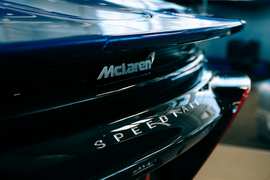
The McLaren Speedtail: The Ultimate Grand Tourer
McLaren, a name synonymous with racing pedigree and innovation, has always occupied a unique space in the automotive hierarchy. While other manufacturers chase lap times, McLaren has often focused on the ultimate driving experience. The Speedtail is the embodiment of this philosophy, representing the spiritual successor to the legendary McLaren F1, but with a modern, hyper-GT twist.
The Speedtail is instantly recognizable by its elongated, teardrop-shaped silhouette. This design is not merely for aesthetics; it is a triumph of aerodynamic efficiency. The car features a central driving position, reminiscent of the F1, but with a futuristic, digital cockpit that eschews traditional buttons and dials in favor of touch-sensitive displays.
Power comes from a hybrid powertrain that combines a McLaren-developed V8 engine with electric motors to produce a combined output of 1,036 horsepower. This allows the Speedtail to achieve a top speed of 250 mph, but more importantly, it delivers that speed with effortless grace. The ride is supple, the cabin is hushed, and the driving experience is sublime. The Speedtail is a car that proves that a hypercar doesn’t need to be an ordeal to drive; it can be a joy. It is the perfect machine for the collector who wants to cover vast distances in absolute comfort and style, without sacrificing a shred of performance.
The Pagani Huayra R: A Track-Only Masterpiece
Horacio Pagani is an artist who happens to build cars. His creations are instantly recognizable for their exquisite attention to detail, their beautiful materials, and their handcrafted perfection. The Huayra R takes this philosophy to its most extreme conclusion, stripping away the concessions required for road legality to create a pure, unadulterated track weapon.
The Huayra R is a collaboration between Pagani and HWA AG, a company renowned for its motorsports expertise. The result is a car that looks less like a production vehicle and more like a piece of kinetic sculpture. The bodywork is a symphony of carbon fiber and titanium, sculpted to generate immense downforce. The gullwing doors open to reveal a cockpit that is a testament to Pagani’s obsession with detail, featuring a stunning array of exposed mechanical components and exquisite materials.
Under the rear clamshell lies a naturally aspirated V12 engine developed by HWA AG. This powerplant is a work of art in itself, producing 850 horsepower and revving to an exhilarating 9,000 rpm. The engine is integrated into the car’s chassis, acting as a structural element and contributing to the car’s