
The World’s Most Extreme Machines: A Deep Dive into the Top 10 Hypercars Redefining Automotive Excellence
In the high-octane realm of automotive engineering, where the pursuit of speed, luxury, and technological innovation knows no bounds, the hypercar stands as the ultimate symbol of human ingenuity. These are not merely cars; they are rolling sculptures, technological marvels, and the bleeding edge of performance technology. Born from the crucible of competition and refined through relentless innovation, the best hypercars in the world represent the pinnacle of what is possible when engineers are given the freedom to dream without the constraints of convention.
For the uninitiated, the line between a supercar and a hypercar can seem blurry. Both are exclusive, low-volume machines built by specialist manufacturers, both command astronomical prices, and both deliver performance figures that defy belief. However, the hypercar exists on an entirely different plane. It takes the already extraordinary capabilities of a supercar and cranks them up to eleven, pushing the boundaries of physics, materials science, and aerodynamic design.
If a supercar is a precision-engineered scalpel, a hypercar is a laser-guided missile. These machines blend the raw, visceral thrill of racing with the opulent comfort of a luxury limousine, creating an experience that is both terrifyingly fast and surprisingly refined. But what truly sets a hypercar apart is its soul. It’s the obsessive attention to detail, the use of materials typically reserved for aerospace applications, and the sheer audacity of its engineering that places these vehicles in a class of their own.
For the average driver, owning a hypercar is little more than a pipe dream. With price tags that rival small nations and production runs that are often measured in the mere dozens, these machines are reserved for an elite few. But the beauty of the hypercar isn’t just in the driving; it’s in the inspiration. The technological leaps made in the development of these ultimate machines often trickle down to more attainable vehicles, pushing the entire automotive industry forward.
In this comprehensive guide, we’ll explore the crème de la crème of the automotive world. We’ll delve into the engineering marvels that power these beasts, the design philosophies that shape their stunning aesthetics, and the performance metrics that leave even the most seasoned drivers breathless. From the carbon-fiber monoliths of Aston Martin to the electric-hybrid juggernauts from Mercedes-AMG, this is your front-row seat to the most exclusive show on earth.
The Aston Martin Valkyrie: A Street-Legal Fighter Jet
When you think of Aston Martin, you might picture the sophisticated elegance of James Bond’s iconic DB5. But with the Valkyrie, Aston Martin decided to throw out the rulebook entirely and create something that looks like it was beamed directly from the cockpit of a fighter jet. Developed in collaboration with Red Bull Racing’s legendary Formula 1 designer, Adrian Newey, the Valkyrie is less a car and more a piece of aerodynamic sculpture that happens to have wheels.
The very name, Valkyrie, evokes images of Norse mythology, where these divine female figures chose who lived and died in battle. This Aston Martin carries that same sense of powerful destiny. From its impossibly low stance to its gaping underbody tunnels that channel air with surgical precision, every curve and crevice of the Valkyrie’s carbon-fiber body is designed to cheat the wind. It’s a masterclass in “form follows function,” where the aesthetics are a direct result of uncompromising aerodynamic demands.
But the Valkyrie isn’t just about looking the part; it’s about delivering a driving experience that is nothing short of otherworldly. At its heart lies a Cosworth-developed, naturally aspirated 6.5-liter V12 engine. This isn’t just any V12; it’s a high-revving masterpiece that screams to a staggering 11,100 RPM, producing a symphony of mechanical fury that has to be heard to be believed. Combined with a Rimac-built hybrid system that adds electric boost exactly where it’s needed, the Valkyrie produces a combined output of over 1,160 horsepower.
To put that into perspective, that’s more power than most modern fighter jets. But raw power is only part of the equation. The Valkyrie’s true genius lies in its obsession with weight. With a target weight of just 1,030 kilograms (about 2,270 pounds), it achieves a near-perfect 1:1 power-to-weight ratio. This isn’t just fast; it’s an exercise in physics-defying agility. The result is a car that can accelerate from 0 to 60 mph in under 2.5 seconds and reportedly generate lateral G-forces that would make a fighter pilot’s helmet feel light.
Inside, the cabin is a snug, driver-focused cocoon. With no traditional dashboard, information is projected onto the windshield via a digital display, keeping your eyes focused on the road ahead. The seats are essentially molded into the carbon-fiber monocoque, providing a level of intimacy with the car that is both exhilarating and slightly intimidating.
The Aston Martin Valkyrie is a testament to what happens when a storied marque like Aston Martin teams up with the best minds in Formula 1. It’s a car that pushes the boundaries of what is road-legal, challenging the very notion of what a car can be. It’s expensive, exclusive, and utterly magnificent – a true icon of the hypercar era.
The Bugatti Chiron: The Ultimate Expression of Automotive Power
When Bugatti unveiled the Chiron, it had a Herculean task on its hands: to succeed the Veyron, a car that is widely credited with creating the modern hypercar genre. The Veyron was a technological marvel that redefined what was possible on four wheels, and many wondered if Bugatti could possibly top it. With the Chiron, they didn’t just top it; they obliterated the benchmark and set a new standard for automotive excellence.
The Chiron is, in many ways, the ultimate expression of automotive power. At its heart lies the legendary Bugatti W16 engine, an engineering masterpiece that displaces 8.0 liters and is fitted with four turbochargers. This quad-turbocharged leviathan produces a mind-boggling 1,500 horsepower and a staggering 1,600 Newton-meters of torque. To handle this immense power, Bugatti developed a bespoke two-speed transmission that can shift gears faster than a human brain can process information.
The result is a car that feels less like it’s accelerating and more like it’s being launched from a catapult. The 0-60 mph sprint is dispatched in a scarcely believable 2.4 seconds, but that’s just the appetizer. Push harder, and the Chiron continues to surge forward with relentless intensity. The top speed is electronically limited to 261 mph (420 km/h) to protect the tires, but in testing, the Chiron has unofficially clocked speeds well over 300 mph. It’s a car that makes the Autobahn feel like a city street.
But the Chiron is far more than just a straight-line speed machine. What makes it a true hypercar is its ability to deliver this staggering performance with an almost serene level of composure. Inside the cabin, you’re enveloped in a world of opulence. Hand-stitched leather, polished aluminum, and carbon fiber trim create an atmosphere of refined luxury. The controls are tactile and precise, providing a satisfying sense of connection between driver and machine.
The design of the Chiron is a masterclass in balancing aggression with elegance. Its iconic “C” line, a sweeping curve that bisects the car’s profile, pays homage to the Art Deco heritage of the Bugatti brand while providing crucial aerodynamic channeling. The massive horseshoe grille, a Bugatti signature, is not just for show; it’s essential for feeding the hungry W16 engine with the massive quantities of air it requires.
Bugatti’s approach to the Chiron is unique in the hypercar world. While other manufacturers focus on lightweight construction and raw, visceral experiences, Bugatti has embraced the idea of the “grand tourer hypercar.” It’s a vehicle that can cross continents at triple-digit speeds in absolute comfort, making the journey as exhilarating as the destination.
The Chiron is a statement of intent, a declaration that Bugatti remains the undisputed master of the automotive realm. It’s a car that combines the raw power of a drag racer, the handling of a track weapon, and the luxury of a private jet, creating an experience that is simply unmatched.
The Lamborghini Aventador: The Epitome of Italian Drama
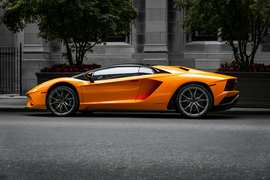
When you think of Lamborghini, you think of drama. You think of sharp angles, outrageous styling, and an engine note that sounds like a pack of wolves fighting in a tin shed. The Lamborghini Aventador is the personification of that philosophy. It’s a car that doesn’t just demand attention; it commands it. From the moment you lay eyes on it, the Aventador makes its intentions clear: this is not a car for the faint of heart.
The Aventador’s design is a visceral, unapologetic celebration of Italian automotive artistry. Its silhouette is a study in aggressive geometry, with sharp creases, deeply sculpted side intakes, and a low, menacing stance that looks glued to the pavement. The signature scissor doors, a hallmark of Lamborghini’s V12 flagships, swing upward with theatrical flair, ensuring that the arrival is as much a part of the experience as the drive itself.

But the visual drama is only the beginning. Underneath that stunning carbon-fiber bodywork lies the beating heart of the beast: a naturally aspirated 6.