
The Billion-Dollar Garage: Unpacking the World’s Most Expensive Cars Ever Sold
The automotive landscape is a fascinating blend of the practical and the fantastical. On one end of the spectrum, we have the reliable daily drivers—the workhorses that get us to the office, ferry the kids to soccer practice, and handle the weekly grocery run. These are the cars that make up the bulk of the market, offering value, efficiency, and everyday utility. But tucked away in private collections, behind climate-controlled doors and guarded by security systems, exists another world entirely—a realm where cars transcend mere transportation to become bona fide works of art, historical artifacts, and legendary status symbols.
These are the most expensive cars ever sold, vehicles that command prices so astronomical they make a luxury mansion seem almost affordable by comparison. We’re not talking about high-end performance models or limited-edition supercars that push the boundaries of automotive engineering. We’re talking about mechanical rarities that have transcended their original purpose to become the stuff of legend. These vehicles represent the zenith of automotive design, the pinnacle of racing heritage, and the ultimate expression of collector obsession.
Understanding why these machines command such staggering valuations requires looking beyond horsepower figures and 0-60 mph times. It involves delving into a complex interplay of scarcity, provenance, historical significance, and the psychological allure of owning something truly unique. For the select few who can afford these automotive titans, the purchase is often less about the act of driving and more about the prestige of ownership, the thrill of the hunt, and the desire to possess a tangible piece of history.
Join us as we embark on a journey into the rarefied atmosphere of the world’s most expensive cars. We’ll explore the stories behind these mechanical marvels, the audacious figures they commanded at auction, and the intangible qualities that elevate them from mere automobiles to legendary icons. Whether you’re a lifelong gearhead, a casual admirer of automotive beauty, or simply someone curious about the outer limits of the collector car market, this exploration promises to be as enlightening as it is astonishing.
The Apex Predator: 1955 Mercedes-Benz 300 SLR Uhlenhaut Coupé – $142 Million
Topping the list of the most expensive cars ever sold is a vehicle that defies conventional description. The 1955 Mercedes-Benz 300 SLR Uhlenhaut Coupé is not just a car; it’s a legend, a myth, and a near-religious artifact in the automotive pantheon. Its record-shattering sale price of $142 million (approximately £115 million at the time of sale) in 2022 sent shockwaves through the collector car world, establishing a benchmark that may never be surpassed.
What makes this automotive icon worth more than a fleet of supercars, a private island, or a small corporate jet? The answer lies in a confluence of factors that converge to create a perfect storm of desirability. At its heart, the 300 SLR Uhlenhaut Coupé is a direct descendant of one of the most dominant racing cars in history, the W196 Formula 1 car that carried Juan Manuel Fangio to two world championships. The Uhlenhaut Coupé was essentially a road-legal version of this Grand Prix legend, featuring the same high-performance chassis and powertrain but encased in a stunning, aerodynamically optimized coupe bodywork.
The “Uhlenhaut” designation comes from its creator and namesake, Rudolf Uhlenhaut, the brilliant and visionary engineer who served as the head of Mercedes-Benz’s racing department. Uhlenhaut, a man of immense talent and impeccable taste, envisioned a road-going version of the W196 that could be driven to races, raced in the grueling Mille Miglia endurance race, and then driven back to the factory—a testament to the car’s engineering prowess and reliability.
Only two prototypes were ever built, and one of them, chassis number 722 (named for its starting time of 7:22 AM in the 1955 Mille Miglia), was famously driven by Uhlenhaut himself on public roads. This specific car, the very one that sold for a staggering $142 million, was the only one to feature the enclosed coupe bodywork. The other 300 SLR models produced were open-top “barchetta” style race cars. This extreme rarity—just one example of this specific configuration exists—is a primary driver of its astronomical valuation.

Beyond its rarity, the car’s provenance is impeccable. It remained in the possession of Mercedes-Benz itself for decades, housed in the company’s private collection and rarely, if ever, seen by the public. When Mercedes-Benz decided to part with this automotive treasure, they did so through a highly secretive, invitation-only auction conducted by RM Sotheby’s at the company’s museum in Stuttgart, Germany. Only a select group of the world’s most discerning collectors were invited to participate, adding an aura of exclusivity and mystique to the event.
The buyer, who has chosen to remain anonymous, reportedly outbid other ultra-wealthy collectors in a tense bidding war that saw the price skyrocket in its final moments. The sale shattered the previous record for the most expensive car ever sold—held by a 1962 Ferrari 250 GTO that fetched $48.4 million in 2018—by a margin of nearly $100 million. This wasn’t just a transaction; it was a historical event that recalibrated the understanding of value in the collector car market.
The significance of the Uhlenhaut Coupé extends beyond its financial valuation. It represents the zenith of post-war German automotive engineering, a period when Mercedes-Benz dominated international motorsport. The car’s advanced technology for its time, including its lightweight tubular space frame, sophisticated suspension system, and high-performance engine, set benchmarks that influenced automotive design for decades to come.
Moreover, the car’s aesthetic appeal is undeniable. The sleek, aerodynamic lines of the coupe body, penned by Uhlenhaut himself, are a masterclass in automotive sculpture. The gullwing doors, a signature feature of the 300 SLR, add a dramatic flourish that enhances its visual impact. The silver paint, often referred to as “Silver Arrow,” is instantly recognizable and synonymous with Mercedes-Benz’s racing heritage.
In the eyes of collectors, the Uhlenhaut Coupé is more than just a car; it’s a time capsule, a direct link to a golden era of motorsport when engineering genius and driving bravery converged to create something truly extraordinary. It’s a tangible connection to Rudolf Uhlenhaut, a man whose vision and passion shaped the very essence of the vehicle. And for the anonymous buyer, it’s the ultimate prize, a crown jewel in a collection that likely already contains some of the world’s most sought-after automobiles. The $142 million price tag, while staggering to the average person, represents a small price to pay for the opportunity to own a piece of automotive history that is, quite literally, irreplaceable.
The Holy Grail of Ferraris: 1962 Ferrari 250 GTO – $48.4 Million (and Rising)
While the 1955 Mercedes-Benz 300 SLR Uhlenhaut Coupé currently holds the record for the most expensive car ever sold at auction, the title for the most expensive car sold in a private sale—and the most coveted of all collector cars—belongs to the 1962 Ferrari 250 GTO. This automotive icon commands a price that seems to appreciate with every passing year, with reports of private sales fetching prices upwards of $70 million and even rumors of a staggering $100 million transaction.
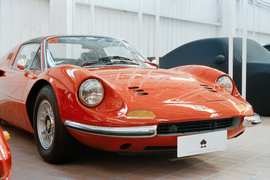
To understand the allure of the 250 GTO, one must delve into the romanticized era of 1960s Grand Touring racing. The 250 GTO (Gran Turismo Omologato) was created by Ferrari to compete in the FIA’s prestigious GT racing series. The “Omologato” designation meant that the car had to be produced in a minimum number of units to qualify for racing, with 100 cars required for Homologation. However, due to the exclusivity of Ferrari’s V12 engine production and the car’s revolutionary design, Ferrari managed to homologate the GTO with a production run of just 36 units between 1962 and 1964. This extreme scarcity—less than 40 examples of this legendary machine exist in the world—is the primary driver of its stratospheric valuation.
But the 250 GTO’s value extends far beyond its rarity. It represents the perfect marriage of beauty and performance. Designed by the legendary Giotto Bizzarrini, who was then Ferrari’s chief engineer, the 250 GTO features one of the most aesthetically pleasing body shapes ever conceived. Its long bonnet, muscular haunches, and gracefully sloping rear deck create a profile that is both aggressive and elegant. The car’s design was born out of function—Bizzarrini utilized wind tunnel testing (a rarity for road cars at the time) to optimize aerodynamics for high-speed stability on race tracks like the Nürburgring and Monza.
Underneath its stunning exterior lies a mechanical masterpiece. The 250 GTO is powered by the legendary 3.0-liter Colombo V12 engine, one of the most celebrated powerplants in automotive history. This engine, derived from Ferrari’s successful 250 Testa Rossa race car, produces around 300 horsepower, allowing the GTO to achieve top speeds of over 150 mph and conquer demanding circuits with ease. The engine