
The Most Expensive Cars Ever Sold: A Peek into Automotive Royalty
For the vast majority of drivers, the price of a new car is a carefully calculated equation of need, budget, and maybe a little bit of “what would the neighbors think?” We compare MPG, check insurance quotes, and debate the merits of heated seats until our eyes glaze over. But somewhere on the other side of the automotive universe, there exists a stratum of vehicles so rare, so historically significant, and so breathtakingly beautiful that they trade for sums that dwarf the GDP of small nations. We’re talking about cars that don’t just get from A to B; they are tangible pieces of art, rolling sculptures that represent the pinnacle of engineering and design from a bygone era.
At the heart of this multi-million-dollar marketplace is a simple, immutable truth: rarity commands a premium. When a manufacturer produces only a handful of vehicles, or when a specific chassis wins a legendary race, its value transcends mere transportation. It becomes a historical artifact, a blue-chip investment, and a totem of status that few will ever touch, let alone own. This is the world of the world’s most expensive cars ever sold—a realm where the price tag reads like a phone number and the bidding wars sound like something out of a spy thriller.
But what exactly drives these astronomical valuations? It’s rarely about the raw performance figures, though these cars are invariably fast. Instead, the market is driven by a confluence of factors: provenance (who owned it and what did they do with it?), historical significance (did it win a championship? was it the first of its kind?), condition (is it concours-perfect or a rusty relic?), and, perhaps most importantly, the psychological allure of owning something that almost no one else on the planet can possess.
From the hallowed halls of Maranello to the engineering bays of Stuttgart, certain names appear with a regularity that borders on obsession for collectors. Ferrari, with its storied racing legacy, dominates the upper echelons of this list, its Prancing Horse emblem seemingly forged from pure gold in the eyes of the elite. Mercedes-Benz, with its pre-war Grand Prix dominance and post-war technological prowess, offers another avenue to ultimate automotive nirvana. And then there are the niche players—Bugatti, Duesenberg, Zagato—each with a story so singular that it commands its own mythology.
This isn’t just about rich people buying expensive toys. It’s about the preservation of mechanical history, the continuation of a specific craft, and the ultimate expression of passion for the automobile. For those of us who appreciate the symphony of a V12 engine or the graceful sweep of a hand-formed aluminum body, these sales are a source of both awe and vicarious thrill. Let’s pull back the velvet rope and take a look at the titans of the automotive world—the cars that have shattered records, defied logic, and redefined what a car can be worth.
The 1955 Mercedes-Benz 300 SLR Uhlenhaut Coupé: The £107 Million King
If you want to start at the absolute apex, the pinnacle of automotive valuation, there is only one car that matters. The 1955 Mercedes-Benz 300 SLR Uhlenhaut Coupé doesn’t just hold the record for the most expensive car ever sold; it obliterate every previous record with such force that it rendered them mere footnotes. Sold in a clandestine auction at the Mercedes-Benz Museum in Stuttgart in 2022, this automotive icon fetched a staggering €135 million, which, at the time, translated to approximately £107 million (or about $142 million).
To understand this price, you have to understand the car. This isn’t just a 300 SLR; it is the 300 SLR. Of the ten 300 SLR “Uhlenhaut Coupés” built, only two ever existed. These weren’t even production cars in the traditional sense. They were road-legal prototypes of the W196 R Grand Prix car, stripped of their racing-specific aerodynamic wings and fitted with proper doors, windows, and interiors, transforming them from Le Mans-conquering thoroughbreds into road-going monsters. They were the private playthings of Rudolf Uhlenhaut, the chief engineer who essentially willed the Mercedes-Benz racing program into existence.
Legend has it that Uhlenhaut would drive his personal coupe from Stuttgart to Monaco for the Grand Prix, covering the 1,000 km distance in under 10 hours, with an average speed of over 100 mph. This wasn’t a car built for show; it was built to be driven fast—dangerously fast. With a 3.0-liter straight-eight engine producing around 300 horsepower and a top speed approaching 180 mph, it was the fastest road car in the world in 1955.
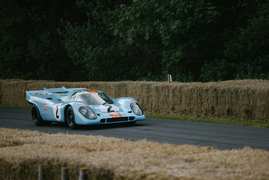
The car that sold in 2022—chassis number 722 (named for its race number, which corresponded to its start time of 7:22 AM at the Mille Miglia)—was essentially Uhlenhaut’s personal mobile office. It was purchased from Mercedes-Benz by a private collector who outbid a cabal of the world’s wealthiest enthusiasts in a nail-biting auction conducted by RM Sotheby’s. The proceeds from the sale were used by Mercedes-Benz to establish the “Mercedes-Benz Fund,” a global scholarship program for environmental science and decarbonization research, giving the sale an altruistic narrative that only added to its luster.
For the automotive cognoscenti, this sale was the culmination of a dream. The Uhlenhaut Coupé represents the zenith of a specific era of Mercedes-Benz engineering—the “Silver Arrows” period—before the company withdrew from motorsport after the tragic 1955 Le Mans accident. Its rarity (only two exist), its provenance (the personal car of the chief engineer), and its performance (the fastest road car of its day) combine to create a trifecta of desirability that may never be replicated. It is, quite simply, the Mona Lisa of the automotive world.
The 1962 Ferrari 250 GTO: The Holy Grail of the Collector Market
Before the 300 SLR shattered the record, the king for nearly a decade was the 1962 Ferrari 250 GTO. This isn’t just a valuable car; it’s the benchmark against which all other collector cars are measured. A 250 GTO in concours condition is the ultimate prize for any Ferrari aficionado, and when one comes up for sale, the automotive world stops spinning.
In 2018, a specific 250 GTO—chassis number 3413 GT—was sold privately for a reported $70 million (approximately £56 million at the time). This sale confirmed what many had long suspected: the 250 GTO had transcended the realm of cars and entered the stratosphere of fine art.
Why the GTO? The story begins in 1961 when Enzo Ferrari recognized that his 250 GT SWB Berlinetta, while dominant on the track, was being outpaced by the likes of the Jaguar E-Type and the Aston Martin DP212. He tasked Giotto Bizzarrini, the legendary engineer often referred to as “The Sorcerer of Maranello,” with creating a new car to dominate the FIA’s new Group 3 Grand Touring Car category. Bizzarrini’s solution was radical. He took the proven 3.0-liter V12 engine from the 250 Testa Rossa racer and shoehorned it into a lighter, more aerodynamic chassis.
The result was the 250 GTO, which stands for Gran Turismo Omologato (Grand Touring Homologated). To qualify for racing, Ferrari needed to produce at least 100 examples, but political infighting and production realities limited the total run to just 36 cars between 1962 and 1964. Each GTO was essentially hand-built, with subtle variations between the Series I (1962-63) and the Series II (1964) aerodynamic designs.
The 3413 GT that sold in 2018 is a particularly special example. It wasn’t just a showroom car; it was a factory racer. It competed in the 1962 Targa Florio, finishing second overall, and later won its class at the 1964 Tour de France. It changed hands a few times, eventually ending up in the ownership of Italian industrialist Fabrizio Violati, who kept it in his private collection for nearly 50 years. When he finally decided to sell it, the asking price was astronomical, and the buyer, an American collector, paid a premium to acquire it.
The appeal of the GTO is multi-faceted. Visually, it is arguably one of the most beautiful cars ever conceived, with its long hood, short deck, and triple-intake grille that gives it a predatory, aggressive stance. Mechanically, it is a masterpiece of 1960s engineering, offering a visceral driving experience that is unmatched by modern computers and electronic nannies. But most importantly, it is rare. With only 36 examples in existence, and at least a few having met unfortunate ends in racing accidents, the number of perfect, road-legal GTOs is even smaller. This scarcity, combined with the Ferrari mystique and the car’s undeniable racing pedigree