
The $30 Million Ferrari: Unpacking the World’s Most Exclusive Hypercars
For the vast majority of us, a car is simply a tool—a means to get from Point A to Point B. It’s a practical necessity, perhaps adorned with a few personal touches, but ultimately defined by its utility. Then there’s the other end of the automotive spectrum, where the price tag ceases to be a measure of value and instead becomes a badge of honor. In this rarefied atmosphere, cars are not merely machines; they are rolling sculptures, technological marvels, and potent symbols of status that operate entirely outside the realm of everyday logic.
The global market for these automotive extravaganzas is a fascinating study in wealth allocation. While the average consumer grafles with gas prices and insurance premiums, a select group of collectors competes for the rarest, most powerful, and most visually audacious vehicles ever conceived. These aren’t just cars; they are liquid assets that appreciate over time, often selling for more than their original sticker price years after they roll off the assembly line.
This exclusive category bypasses the high-end luxury sedans and performance coupes that dominate the $150,000 to $300,000 bracket. We are talking about vehicles that cost more than mansions, more than private jets, and in some cases, more than the GDP of small nations. The production numbers are deliberately minuscule—sometimes just a single digit—ensuring that ownership remains a privilege reserved for a tiny fraction of the world’s elite.
From the windswept coasts of Denmark to the historic heart of Italy, the creation of these hypercars involves a convergence of engineering genius, artisanal craftsmanship, and audacious design. Engineers push the boundaries of physics with hybrid powertrains and carbon-fiber construction, while designers abandon convention, resulting in vehicles that often look like they’ve landed from another dimension.
Join us as we embark on an exhaustive journey through the upper echelons of automotive finance. We’ll dissect the specifications, explore the cultural significance, and reveal the jaw-dropping figures that make these machines the most expensive cars in the world.
The Zenvo ST1: Danish Power Unchained ($1.2 Million)
Our countdown begins in Zealand, Denmark, the birthplace of a car that defies easy categorization. The Zenvo ST1 is less a refined sports car and more a raw, unfiltered expression of brute force. Its identity is forged in the crucible of its powertrain, where a massive 6.8-liter V8 engine is subjected to the dual tyranny of both a supercharger and a turbocharger.
The resulting statistics are nothing short of obscene. This combination unleashes a staggering 1,104 horsepower and 1,054 pound-feet of torque, all of which are ruthlessly channeled to the rear wheels. In an era where electrification is softening the edges of performance vehicles, the ST1 remains a gloriously analog brute. It requires respect, skill, and perhaps a degree of bravery to pilot at its limits.
The design mirrors its mechanical ferocity. With gull-wing doors, aggressive aerodynamics, and a body sculpted from lightweight carbon fiber, the ST1 looks perpetually ready for battle. While its top speed is electronically limited, its acceleration is violent, pinning the driver to the contoured leather seat with relentless force.
The Zenvo philosophy centers on producing just a handful of these vehicles per year, ensuring that each owner receives a personalized piece of Danish engineering prowess. It is a statement piece that announces the owner’s arrival with a deafening roar and a visual spectacle that few other cars can match. For those who believe that true luxury lies in exclusivity and unadulterated power, the ST1 represents a compelling proposition in the hypercar landscape.
The Ferrari LaFerrari: A Hybrid Masterpiece ($1.4 Million)
When Enzo Ferrari himself decreed that the company would never produce a front-engined car again, he set a precedent for a lineage of mid-engined, uncompromising performance machines. The LaFerrari, Italian for “The Ferrari,” is the spiritual successor to the legendary F40 and Enzo Ferrari, embodying the pinnacle of the Prancing Horse’s engineering might.
Visually, the LaFerrari is a masterpiece of aerodynamic sculpture. Its bodywork is a symphony of carbon fiber, shaped by wind tunnels to generate downforce that presses the car to the pavement as speeds climb. The dihedral doors swing upward, revealing a cockpit that is driver-focused to the extreme, eschewing unnecessary gadgets for pure driving telemetry.
But its true genius lies beneath the surface. The LaFerrari was the first hybrid vehicle in Ferrari’s history, a technological tour de force that integrated a naturally aspirated V12 engine with an advanced KERS (Kinetic Energy Recovery System). This system, borrowed directly from Formula 1 technology, captures energy during braking and deploys it instantly to the electric motor, providing a surge of torque exactly when needed.
The result is a combined output that eclipses 900 horsepower, propelling the car from 0 to 60 mph in less than 3.0 seconds. The sensation of acceleration is often described as physics-defying, a seamless blend of internal combustion thunder and electric immediacy.
The LaFerrari is more than just fast; it is a rolling testament to Ferrari’s heritage and its forward-looking vision. With a production run limited to just 499 units, it represents the zenith of Ferrari’s hybrid hypercar era, fetching astronomical prices on the secondary market as collectors vie for a piece of Maranello history.
The Pagani Huayra: The God of Winds ($1.4 Million)
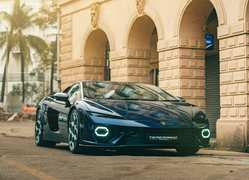
In the world of automotive artistry, few names command as much reverence as Horacio Pagani. The Argentine engineer transformed the supercar industry by proving that a vehicle could be both mechanically brilliant and breathtakingly beautiful. His creation, the Huayra, is a testament to this philosophy.
Named after the Incan God of Winds, the Huayra (pronounced “why-rah”) embodies the very essence of speed and fluidity. From every angle, the car appears to be in motion, even when standing still. Its bodywork is a study in organic aerodynamics, featuring complex curves, active aero flaps that adjust in real-time, and a central spine that flows uninterrupted from the front splitter to the rear diffuser.
The mechanical heart of the Huayra is a handcrafted V12 engine sourced from AMG, Pagani’s long-standing technical partner. This twin-turbocharged unit produces over 700 horsepower, but its true magic lies in its responsiveness. Pagani’s obsession with detail ensures that the throttle response is immediate, making the car feel alive and connected to the driver’s every input.
Inside, the Huayra is a sanctuary of luxury and craftsmanship. The cabin is swathed in hand-stitched leather, exposed carbon fiber, and polished aluminum, creating an atmosphere that feels more like a private jet cockpit than a car interior. Every switch, every dial, every surface has been meticulously considered and executed.
The Huayra represents the ultimate expression of Pagani’s vision: a car that engages the senses, challenges the mind, and soothes the soul. It is a rolling work of art that commands attention wherever it goes, a rare automotive treasure that defines the concept of the modern hypercar.
The Aston Martin One-77: The Ultimate British Catapult ($1.4 Million)
Aston Martin has always occupied a unique space in the automotive pantheon, blending gentlemanly elegance with outright performance. With the One-77, the British marque eschewed subtlety in favor of a no-compromise hypercar that pushed the boundaries of what was thought possible for the brand.
The name itself—One-77—signaled its exclusivity: only 77 examples were ever to be produced. This limited run allowed Aston Martin’s designers and engineers to indulge in a level of bespoke craftsmanship and performance tuning that would be impossible in a mass-produced vehicle.
The centerpiece of the One-77 is its engine, a monstrous naturally aspirated V12 displacing 7.3 liters. In an era of turbocharging, Aston Martin chose to embrace the raw, linear power delivery of a massive-displacement atmospheric engine. The result is a symphonic soundtrack and a power output that was, at the time, the highest ever achieved by a naturally aspirated road car.
This prodigious power is harnessed by a carbon fiber monocoque chassis, providing a rigid foundation for the suspension and powertrain. The bodywork, also crafted from carbon fiber, is a work of art in itself, featuring sweeping lines and aggressive aerodynamic elements that hint at the car’s formidable capabilities.
The interior is a study in British luxury, combining traditional materials like hand-stitched leather and polished wood trim with modern carbon fiber accents. It is a space that feels both opulent and purposeful, reflecting the dual nature of the One-77 as both a grand tourer and a track weapon.
With a top speed exceeding 220 mph and acceleration that pins the driver to the seat, the One-77 is a true hypercar in every sense of the word. It represents the zenith of Aston Martin’s engineering prowess and a fleeting moment in time when the brand produced one of the most exclusive and desirable cars in the world.
The Koenigsegg One:1: The Megacar ($2 Million)

In the rarefied atmosphere of hypercar development, there are few names that command as much respect as Christian von Koenigsegg. The Swedish visionary has built his company on a foundation of innovation, pushing the boundaries of automotive engineering with each successive model. The One:1, however, represents a quantum leap forward,