The Pinnacle of Automotive Extremes: Dissecting the World’s Most Expensive Cars
The automotive landscape of 2025 is a study in contrasts. On one hand, we have the democratization of mobility, with electric vehicles promising efficiency and accessibility for the masses. On the other, there exists a rarefied stratosphere of hypercars and bespoke creations where price tags defy conventional logic. These are not mere modes of transport; they are rolling sculptures, technological marvels, and potent symbols of wealth that push the boundaries of engineering and design. For the discerning collector or the enthusiast captivated by the apex of automotive achievement, understanding this elite segment is essential. Join us as we delve into the world’s most expensive cars, exploring the innovations, craftsmanship, and sheer audacity that justify their astronomical valuations.
The Zenvo ST1: A Danish Berserker ($1.2M)
Our journey into the upper echelon of automotive excess begins in Zealand, Denmark, with the Zenvo ST1. To classify the ST1 merely as a “car” feels like an understatement; it is a mechanical beast meticulously sculpted by a team dedicated to raw, unfiltered performance. The genius of the ST1 lies in its audacious engineering approach—a strategy that eschews hybrid complexity for the brute force of a highly optimized internal combustion engine.
At the heart of this Danish titan beats a 6.8-liter V8 engine, a powerplant enlarged and enhanced to levels that border on the extreme. But Zenvo’s engineers did not stop at mere displacement. They introduced a dual-force induction system, combining the immediate throttle response of a centrifugal supercharger with the high-RPM power delivery of a turbocharger. This synergistic pairing results in an output that is nothing short of staggering: a phenomenal 1,104 horsepower and 1,054 pound-feet of torque. This colossal energy is channeled exclusively to the rear wheels, demanding absolute precision from the driver.
The driving experience in the ST1 is an exercise in sensory overload. Unlike the digitally filtered precision of some modern hypercars, the ST1 offers a raw, visceral connection to the road. The surge of power is immediate and relentless, pressing the driver deep into the Alcantara-trimmed carbon fiber bucket seats. The sound—a symphonic roar of supercharged V8 fury—is a constant reminder of the mechanical violence being unleashed just inches behind the driver’s head.
While its performance metrics place it firmly in the realm of hypercar royalty, the ST1 also serves as a showcase for Zenvo’s commitment to bespoke craftsmanship. Each vehicle is hand-assembled, with an obsessive attention to detail that justifies its premium valuation. The bodywork, crafted from lightweight carbon fiber, is not only aerodynamically functional but also visually arresting, featuring aggressive lines and functional vents that betray the car’s predatory nature.
In a market increasingly dominated by electric hypercars, the Zenvo ST1 stands as a proud bastion of the internal combustion engine. It is a testament to the fact that when engineers are given free rein, unbound by the constraints of mass production or regulatory compromise, the results can be truly extraordinary. For the collector who cherishes the visceral thrill of a powerful engine and the intimacy of hand-built engineering, the Zenvo ST1 remains one of the most compelling—and expensive—choices available.
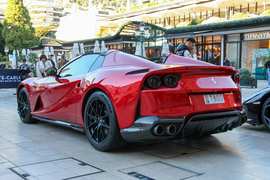
The Ferrari LaFerrari: Italian Elegance Meets Hybrid Power ($1.4M)
When Maranello decides to produce a halo car, the automotive world inevitably holds its breath. The LaFerrari, Italian for “The Ferrari,” is exactly that—the definitive statement from the Prancing Horse, encapsulating the company’s racing heritage and its forward-looking vision for the future of performance motoring. It represents a pivotal moment in Ferrari’s history, being the first production model to feature a hybrid powertrain, a testament to the company’s belief that electrification is not a compromise but an enhancement to performance.
Visually, the LaFerrari is a masterpiece of aerodynamic sculpture. Its design language is directly influenced by Ferrari’s Formula 1 program, resulting in a low-slung, aggressive stance that seems to hug the tarmac even when stationary. The bodywork, crafted from advanced carbon fiber composites, is a study in functional beauty, with every curve and vent serving a precise aerodynamic purpose. The dihedral doors, which swing upwards and outwards, add a dramatic flair that ensures the car commands attention wherever it appears.
Underneath the sweeping bodywork lies a powertrain that perfectly illustrates Ferrari’s hybrid philosophy. The LaFerrari is powered by a 6.3-liter naturally aspirated V12 engine, a glorious powerplant that revs to a spine-tingling 9,250 rpm. This combustion engine is augmented by an electric motor system, which provides instant torque and additional horsepower, effectively eliminating any hint of turbo lag. The combined output is a staggering 950 horsepower, allowing the LaFerrari to obliterate the benchmark 0-60 mph sprint in a blistering 2.9 seconds.
Yet, the true magic of the LaFerrari lies in its driving dynamics. Thanks to the KERS (Kinetic Energy Recovery System) derived from Ferrari’s Formula 1 efforts, the car delivers a seamless and exhilarating surge of acceleration. The steering is telepathic, the chassis incredibly responsive, and the braking performance, thanks to the integration of regenerative braking, is nothing short of phenomenal. It is a car that feels alive under the driver, communicating every nuance of the road surface through the steering wheel and the seat of the pants.
The interior is a driver-focused cockpit, clad in premium leather and carbon fiber. The seats are fixed, molded to the occupants for optimal support during high-performance driving, with the pedals and steering wheel adjustable to achieve the perfect driving position. This focus on the driving experience, rather than mere luxury, is a hallmark of Ferrari’s approach to its halo cars.
As one of Ferrari’s most iconic models, the LaFerrari represents a significant milestone in automotive history. It proved that hybrid technology could be embraced without sacrificing the soul of a supercar. Today, it remains a highly sought-after collector’s item, a symbol of Italian excellence, and a testament to the enduring allure of the Prancing Horse.
The Pagani Huayra: An Ode to the Gods of Wind ($1.4M)
In the rarefied world of hypercars, few names evoke as much awe and respect as Pagani. Horacio Pagani, an Argentinian engineer with a background in aerospace and a deep appreciation for the artistry of Leonardo da Vinci, has built a legacy on the principle that a car should be both a mechanical marvel and a work of art. The Huayra, the successor to the iconic Zonda, is the embodiment of this philosophy.
The name itself, Huayra (pronounced why-rah), is a nod to the Incan God of Wind, fitting for a car designed with such meticulous attention to aerodynamics. Pagani’s approach to design is unique in the industry. While most manufacturers focus on wind tunnel testing, Pagani utilizes advanced computational fluid dynamics and physical models to create shapes that are both stunningly beautiful and aerodynamically exceptional. The Huayra features an active aerodynamic system with four flaps that adjust independently to optimize downforce and drag depending on the driving situation, a feature that contributes to its remarkable agility and stability at high speeds.
The exterior of the Huayra is a breathtaking display of carbon-titanium composite construction. This advanced material, a signature of Pagani’s engineering prowess, is incredibly strong yet remarkably lightweight. The bodywork is adorned with intricate details, such as the exposed suspension components and the central quad-exhaust system, all crafted with an obsessive attention to detail. The craftsmanship extends to the interior, where the Huayra transforms into a luxurious cockpit that rivals the finest bespoke suits. Hand-stitched leather, polished aluminum, and exposed carbon fiber blend seamlessly to create an environment that is both opulent and functional.
Powering the Huayra is a Mercedes-AMG sourced 6.0-liter twin-turbocharged V12 engine. This powerplant is a masterpiece of engineering in its own right, producing 620 horsepower and a massive 740 pound-feet of torque. The torque delivery is particularly impressive, providing relentless acceleration that pushes the driver back into the seat with unrelenting force. The engine is mated to a seven-speed sequential transmission, which has been specifically developed for the Huayra, offering lightning-fast shifts that further enhance the car’s exhilarating performance.
The driving experience in the Huayra is an ethereal blend of speed and sophistication. The car is incredibly agile, thanks to its lightweight construction and advanced aerodynamics, allowing it to carve through corners with precision and confidence. The ride quality, despite the car’s performance capabilities, is remarkably compliant, thanks to the sophisticated suspension system and the active aerodynamic elements that help to smooth out the ride.
The Pagani Huayra is more than just a fast car; it is a rolling work of art, a testament to the passion and vision of its creator. Each vehicle is built to order, with customers having the opportunity to personalize their cars to an extraordinary degree. This bespoke approach, combined with the car’s exceptional performance and breathtaking design, ensures that the Huayra remains one of the most desirable and expensive automobiles in the world.
The Aston Martin One-77: British Elegance and Raw Power ($1.4M)

Aston Martin, a name synonymous with timeless British elegance and sporting luxury, rarely ventures into the realm of extreme hypercars. When the company does decide to produce a limited-run machine that pushes the boundaries of performance, the results are nothing short of spectacular. The Aston Martin One-77 is exactly that—a rare and exclusive supercar that combines the brand’s signature sophistication with brute-force engineering to create