
The 10 Most Expensive Cars in the World: A Deep Dive into Automotive Extremes
While most of us navigate the everyday realities of car finance—carefully weighing monthly payments against our budgets for a new hatchback—the world’s wealthiest individuals operate on a completely different financial plane. For the billionaire elite, a standard luxury car like a Rolls-Royce Phantom or Ferrari 12Cilindri is merely a starting point. These collectors demand vehicles that are bespoke, unique, and produced in strictly limited numbers. They are willing to pay prices that dwarf the cost of even the most exclusive production models. These are the ultimate expressions of automotive artistry and engineering prowess: the most expensive cars in the world.
Our journey through the upper echelon of automotive wealth begins with the Bugatti Divo and journeys through the exclusive realms of Pagani, Mercedes-Maybach, Rolls-Royce, and the most extravagant creation from Bugatti.
Bugatti Divo – £4.4 million
If the standard Bugatti Chiron, with its staggering performance figures, somehow fails to satisfy the desires of the ultra-wealthy, the Divo offers a coachbuilt alternative engineered for even greater driving thrills.
Named in honor of Albert Divo, a French-Italian racing driver and air force mechanic who became a works driver for Bugatti in 1928, the car pays tribute to his legacy, which includes an immediate victory in the legendary Targa Florio race. The Divo utilizes the Chiron’s formidable 8-liter, quad-turbocharged W16 engine, producing an astonishing 1,479 brake horsepower. While the 0-62 mph time is quoted at a blistering 2.4 seconds, the Divo’s top speed is intentionally capped lower than the standard Chiron’s, at ‘only’ 236 mph. This limitation is a deliberate consequence of the Divo’s design philosophy, which eschews ‘Top Speed’ mode for enhanced handling dynamics. The car features a substantial 1.8-meter wide fixed rear wing, a larger front spoiler, extended side skirts, and enlarged air intakes, all contributing to increased aerodynamic drag and downforce.
To ensure the Divo is immediately distinguishable from its more common sibling, Bugatti introduced new headlight and taillight designs, along with a wider iteration of the iconic Bugatti horseshoe grille. Production of the Divo was strictly limited to just 40 units, and the entire allocation was sold out on the very first day of ordering. Prospective buyers were offered near-limitless personalization options, ensuring that no two Divos are exactly alike. This level of exclusivity is a hallmark of the world’s most expensive cars, where individual expression commands a premium.
Pagani Huayra Imola Roadster – £4.7 million
For Pagani’s most affluent clientele, the company’s ‘Grand Complications’ division serves as the ultimate destination for bespoke automotive creations. The Huayra Imola Roadster is a prime example of this elite offering, with just eight examples slated for production, each featuring a unique specification curated by its new owner.
The car takes its name from the historic Italian circuit where its chassis was meticulously fine-tuned. Underpinning the Imola Roadster is a highly modified version of Pagani’s signature AMG-sourced twin-turbocharged V12 engine, delivering an impressive 838 brake horsepower. Power is sent exclusively to the rear wheels through a seven-speed sequential gearbox. The top speed is electronically limited to 217 mph, a more rounded 350 kph, reflecting the metric-focused engineering of its Italian creators.
While these figures are formidable, the Imola Roadster is a marvel of lightweight construction compared to the likes of the Bugatti Chiron, tipping the scales at a mere 1,260 kilograms—less than a standard Audi TT. This remarkable weight saving is achieved through the extensive use of exotic composite materials, including the advanced Carbo-Titanium HP62-G2 and Carbo-Triax HP62. These materials are renowned for their exceptional stiffness, which significantly enhances the Pagani’s handling characteristics on the track. Furthermore, the car’s aggressive aerodynamic package, featuring substantial spoilers, generates an additional 900 kilograms of downforce at track speeds, effectively gluing the Imola to the road surface during high-speed cornering.
Pagani Huayra Codalunga – £5.9 million
The name ‘Codalunga,’ meaning ‘longtail’ in Italian, immediately evokes the sleek, elongated designs of the Le Mans-winning sports prototypes from the 1960s. This Pagani creation is a modern interpretation of that classic aesthetic, born from the specific requests of two discerning collectors.
These clients approached Horacio Pagani with a desire for a ‘long-tail’ version of the Huayra Coupé, one that would pay homage to the iconic race cars that competed at Le Mans during the 1960s. Beyond their aesthetic appeal, these streamlined shapes were also paragons of aerodynamic efficiency. After two years of close collaboration with the customers to perfect the design, the Codalunga was finally revealed.
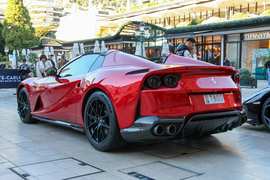
The cars are finished in understated, neutral colors with matte paint finishes, and the interiors feature woven leather upholstery complemented by aluminum components machined from single blocks of metal. The signature four-pipe exhaust system, another nod to the classic Le Mans racers, is finished with a unique ceramic coating. Mechanically, the Codalunga shares the AMG-built twin-turbo 6-liter V12 engine with the Imola Roadster, though in this iteration, it produces 829 brake horsepower, resulting in a top speed of 217 mph.
Beyond the original two commissioning buyers, Pagani produced an additional three examples, bringing the total to five. All five units are fully homologated for use on public roads, though the prospect of sharing space with other drivers in such a potent machine might daaunt all but the bravest owners. The exclusivity of the Codalunga solidifies its position among the most expensive cars ever created.
Mercedes-Maybach Exelero – £6.2 million
Imagine approaching your employer with the request for a new vehicle, not for personal use, but specifically to test tires. This was the unique premise behind the Mercedes-Maybach Exelero. The owners of Fulda, the German subsidiary of Goodyear, commissioned a one-off coupe from Maybach, a vehicle of substantial size, weight, and speed, designed to push the boundaries of tire performance.
This commission was not without precedent. In 1938, Maybach had produced a similar high-speed experimental vehicle, the Maybach SW38, capable of reaching an astonishing 125 mph—a remarkable feat for its era. Sadly, the SW38 was destroyed during World War II, but its spirit and ‘streamliner’ styling cues live on in the Exelero. The Exelero is a substantial machine, weighing 2.6 tonnes despite seating only two occupants. It measures an imposing 5,834 millimeters in length, exceeding the dimensions of a standard Rolls-Royce Phantom. This generous wheelbase allowed for an exceptionally long bonnet, described as being large enough to play tennis on.
Beneath this expansive bonnet lies a V12 engine. Maybach enlarged the standard 5.6-liter unit to 5.9 liters and added two turbochargers, boosting the power output to 691 brake horsepower. The claimed top speed is an impressive 217 mph. The Exelero has graced the silver screen, appearing in various films and television shows, and there were persistent rumors of its acquisition by a prominent rapper. However, the car remains a centerpiece of a German museum, a testament to its unique place in automotive history. Its one-off status and legendary provenance make it a highly coveted machine in the world of the most expensive cars.
Bugatti Centodieci – £7 million
For the billionaire Bugatti aficionado, the mid-1990s classic EB110 Supersport held a special place in the brand’s storied history. The anticipation for a modern successor to this iconic model was palpable, and in 2019, Bugatti finally unveiled the Centodieci—a Chiron-based coupe that pays homage to the EB110 while celebrating the company’s 110th anniversary.
The Centodieci presents a surprisingly distinct visual identity compared to the standard Chiron. It features an entirely revised roofline, a lower front fascia, and a rear section that sits significantly higher. The iconic Bugatti horseshoe grille is scaled down in proportion to the front end, echoing the design of the EB110, while five round air intakes are arranged in a diamond pattern, another direct reference to its predecessor. A long glass engine cover completes the retro-modern aesthetic.
Mechanically, the Centodieci shares the same platform as the Chiron, utilizing Bugatti’s 8.0-liter W16 engine. In this application, however, the engine produces an enhanced 1,578 brake horsepower, enabling the Centodieci to accelerate from 0 to 62 mph in a mere 2.4 seconds. The top speed is electronically limited to just under 240 mph, and the chassis has been further refined to deliver an even sportier driving experience. Production was strictly limited to just 10 hand-built examples, each commanding a unit price of €8 million. The exclusivity and heritage of the Centodieci ensure its place among the world’s most expensive cars.
Bugatti Chiron Profilée – £8.4 million
In the rarefied atmosphere of Bugatti ownership, the prospect of encountering another billionaire in the same model can be a source of considerable anxiety. To