
The 10 Most Expensive Cars in the World: A Deep Dive into Billion-Dollar Automotive Masterpieces
While the average consumer navigates the complexities of a traditional car loan, the world’s ultra-wealthy elite are commissioning bespoke hypercars that command prices reaching into the tens of millions. These aren’t merely vehicles; they are rolling sculptures, engineering marvels, and ultimate status symbols, often far removed from the marque’s standard production models. For the billionaire collector who deems a Rolls-Royce Phantom or a Ferrari 12Cilindri pedestrian, the demand is for the unique, the bespoke, and the strictly limited.
The realm of hypercar pricing operates on a different stratosphere altogether. These machines are frequently reserved for a select clientele, often requiring a level of exclusivity that transcends mere wealth. To acquire one of these automotive legends, one must typically be part of a global elite, where budgets are measured in the hundreds of millions, not the thousands. These are the pinnacle expressions of automotive design and engineering, where budgets are an afterthought and exclusivity is the ultimate currency.
This article delves into the exclusive world of the world’s most expensive cars. We will explore the engineering marvels, the design philosophies, and the astronomical figures that define these automotive titans. Prepare to journey through a landscape where automotive dreams become tangible, and where the very definition of a “car” is elevated to an art form.
Bugatti Divo – £4.4 Million
For the discerning enthusiast who finds the standard Bugatti Chiron wanting in its exclusivity, the Divo emerges as the ultimate solution. This coachbuilt iteration is not merely a faster car; it is a more focused, more visceral driving experience, a testament to Bugatti’s engineering prowess.
Named in honor of Albert Divo, the French-Italian racing driver who secured two victories for Bugatti at the grueling Targa Florio in 1928 and 1929, the Divo pays homage to a legendary era of motorsport. While it shares the Chiron’s formidable 8.0-liter, quad-turbocharged W16 engine, producing a staggering 1,479 bhp, the Divo’s character diverges significantly.
The Divo’s top speed is capped at a still-blistering 236 mph, a deliberate de-tuning from the Chiron’s V-max. This concession is a direct result of its aerodynamic overhaul. The absence of a “Top Speed” mode and the addition of a substantial 1.8-meter wide fixed rear wing, a larger front spoiler, enhanced side skirts, and enlarged air intakes generate a level of downforce that pins the car to the tarmac, transforming cornering dynamics.
Visually, the Divo distinguishes itself with a suite of unique design elements. The headlamps and taillights are reimagined, offering a distinct visual signature. The iconic Bugatti horseshoe grille is widened, adding a more aggressive stance to the front fascia. These subtle yet significant alterations ensure that the Divo is immediately recognizable, a machine set apart from its more common brethren.
Production of the Divo was strictly limited to a mere 40 examples, and the car sold out within hours of its initial unveiling. This exclusivity is further amplified by the near-infinite personalization options afforded to each buyer. No two Divo models are precisely alike, each a unique reflection of its owner’s desires.
Pagani Huayra Imola Roadster – £4.7 Million
Pagani’s ‘Grand Complications’ division is the sanctuary for its most discerning clientele, a realm where the impossible is rendered tangible. The Huayra Imola Roadster is a product of this elite atelier, with only eight examples slated for creation. Each is bestowed with a bespoke specification, meticulously curated by its future custodian.
The Imola’s name pays homage to the legendary Italian circuit where its chassis was honed to perfection. At its heart lies a recalibrated version of Pagani’s AMG-sourced twin-turbo V12 engine, now producing an astounding 838 bhp. This prodigious power is channeled exclusively to the rear wheels through a lightning-fast seven-speed sequential gearbox. The Imola’s top speed is electronically limited to 217 mph, a nod to the metric-loving purists who appreciate the precision of 350 km/h.
Despite its formidable performance credentials, the Imola Roadster is a featherweight compared to its hypercar peers. Weighing in at a scant 1,260 kg, it undercuts the weight of a contemporary Audi TT by a significant margin. This remarkable lightness is attributable to the extensive use of exotic composites, including the advanced Carbo-Titanium HP62-G2 and Carbo-Triax HP62. These materials offer an unparalleled stiffness-to-weight ratio, endowing the Pagani with feline agility and razor-sharp handling responses.
The aerodynamic package is equally impressive. At track speeds, the Imola generates over 900 kg of downforce, effectively gluing the car to the road surface through corners and allowing for lateral G-forces that would challenge the most seasoned drivers.
Pagani Huayra Codalunga – £5.9 Million
The Huayra Codalunga’s name, translating to “long tail” in Italian, belies the sophisticated engineering and design philosophy that birthed this automotive masterpiece. Born from the vision of two discerning collectors who yearned for a ‘long-tail’ iteration of the Huayra Coupé, the Codalunga draws its inspiration from the sleek, aerodynamic forms of 1960s Le Mans racers.
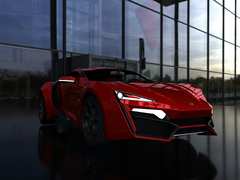
Horacio Pagani and his team dedicated two years to meticulously refining the design in close collaboration with the commissioning clients. The result is a breathtakingly beautiful silhouette that seamlessly blends retro elegance with modern engineering. The cars are finished in muted, sophisticated colors, often rendered in matte paintwork, with interiors appointed in luxurious woven leather and machined aluminum components.
The quad-pipe exhaust system, another nod to the classic Le Mans prototypes, features a ceramic coating that imparts a unique visual and auditory signature. Mechanically, the Codalunga utilizes the same AMG-built 6.0-liter twin-turbo V12 engine as its Huayra siblings, tuned to produce 829 bhp. This powertrain enables a top speed of 217 mph, mirroring the Imola’s capabilities.
Initially commissioned by two collectors, the Codalunga’s allure proved irresistible to a wider audience. A further three examples were subsequently produced, all fully homologated for road use, offering a select group of fortunate individuals the chance to experience this automotive legend on public roads.
Mercedes-Maybach Exelero – £6.2 Million
Imagine the audacity of commissioning a one-off hypercar solely for the purpose of testing tires. This was the reality for Fulda, Goodyear’s German subsidiary, who in 2004, tasked Maybach with creating a vehicle that could meet their stringent performance requirements. The result was the Exelero, a V12-powered coupe of monumental proportions.
The Exelero’s design pays homage to the Maybach SW38, a streamliner from 1938 capable of an astonishing 125 mph for its time. While that historic vehicle was lost during World War II, its spirit and aerodynamic styling cues endure in the Exelero’s breathtaking form.
The Exelero is a behemoth, measuring 5,834 mm in length – longer than a Rolls-Royce Phantom – yet seating only two occupants. Its cavernous engine bay houses a modified V12 engine, its displacement enlarged from the standard Maybach’s 5.6 liters to a formidable 5.9 liters. Augmented by twin turbochargers, the engine produces a commanding 691 bhp, enabling a top speed of 217 mph.
Despite its age, the Exelero has graced the silver screen in various films and television productions. While rumors of a purchase by a prominent rapper circulated for years, the vehicle remains a centerpiece of a German museum, a testament to its unique status in automotive history.
Bugatti Centodieci – £7 Million
For the billionaire Bugatti aficionado awaiting a worthy successor to the iconic EB110 Supersport of the mid-1990s, the wait ended in 2019 with the unveiling of the Centodieci. A Chiron-based coupe, the Centodieci pays homage to the EB110 while celebrating Bugatti’s 110th anniversary.
The Centodieci represents a significant departure from the Chiron’s design language. The roofline is entirely new, the front fascia sits lower, and the rear is dramatically elevated. The iconic Bugatti horseshoe grille is significantly downsized, echoing the EB110’s proportions, while the five round air intakes, arranged in a diamond pattern, and the elongated glass engine cover further reinforce the connection to its predecessor.
Mechanically, the Centodieci retains the Chiron’s formidable 8.0-liter W16 engine, now producing a staggering 1,578 bhp. This power translates to a 0-62 mph time of 2.4 seconds and a top speed electronically limited to just under 240 mph. The chassis has been meticulously retuned to deliver an even more dynamic and engaging driving experience.
Production was capped at a mere 10 examples, each handcrafted and sold prior to its completion at a price of €8 million per unit. The Centodieci is a rolling testament to Bugatti’s heritage, a modern icon that pays homage to its legendary roots.
Bugatti Chiron